This is so unusual for me. I rarely, if ever, follow sports of any type. But I do follow injustice and corporate stupidity, especially when the former is caused by the latter, and both are caused by Bureaucratic, Administrative, and Hierarchical (BAH) conditioned responses. Such is the case with the decision yesterday from Athletics Canada to ban Jeff Adams from competition, and to remove his funding. I posted some of the details of the case, and Jeff responded with considerably more information from the ruling itself.
Every reporter who is covering this story should read Jeff's comment. Every person who self-righteously casts Jeff into the midden heap of ignominy that characterizes those who actually cheat by doping in sports, should read Jeff's comment. Most important, the officials at Athletics Canada should re-read the arbitrator's findings of fact that are quoted in Jeff's comment, and reinstate Jeff Adams!
[Technorati tags: jeff adams | cocaine | athletics canada | injustice]
13 June 2007


12 June 2007
BAH Sports
The unthinking, machine-like drones otherwise known as bureaucrats are at it again, this time from the ivory towers of Athletics Canada. As reported by all the usual suspects, champion paralympian, Jeff Adams, was banned from competition for two years, and has lost his eligibility for funding for the rest of his life. All this because of an erroneous, positive test for cocaine metabolites in his system due to contaminated testing equipment, despite the fact that an arbitrator found as fact that he did not have the drug in his system at the time of competition, and acknowledged that the positive test was indeed the result of an assault and contamination.
That the bureaucrats from Athletics Canada can make statements like,
For shame, Athletics Canada. For shame!
And kudos to Jeff Adams, who maintained his composure and civility during his interview on As It Happens this evening. You are still a hero and an exemplar of perseverance in the face of adversity - particularly when the adversity is caused by those on whom you count for support.
A couple of media notes: The Globe and Mail report conveniently neglects to provide the full facts of the case, namely any mention of the contamination incident. This leads the braying pack animals in its comments section to jump to conclusions about fallen heroes with comparisons to Ben Johnson. Shame on the Globe for such shoddy reportage. The CBC and The Star get it right. And, Athletics Canada has already distanced themselves from association with Jeff Adams. The Google hit now points to a "We're sorry, not found" page. Thank goodness for the Google cache.
[Technorati tags: jeff adams | paralympics | cocaine | injustice]
Adams claimed that an unknown woman inserted cocaine into his mouth at the nightclub. Two witnesses testified on his behalf that there was an immediate commotion at the Vatikan Club, but neither saw the alleged offence.So he was assaulted by an unknown woman in a club - an incident that was witnessed by two other people - and that was the source of the cocaine. He is not a cocaine user; his status as a role-model and an exemplar of sportsmanship and perseverance in the face of adversity is unshaken.
Adams, who needs to self-catheterize, testified that the only catheter he had at the Ottawa race was the one used immediately after the club incident. Scientific experts testified on the likelihood that a catheter contaminated with dried urine from a previous use could lead to the offence. Adams had said that the cost of the catheters meant that he didn't dispose of them after a single use, and admitted they weren't always thoroughly cleaned.
That the bureaucrats from Athletics Canada can make statements like,
"At any time, when there's a positive test, it impacts athletics," Joanne Mortimore, the CEO of Athletics Canada, said on Tuesday. "As far as the implications for athletes with a disability, I think it's the same as a high performance athlete that's tested positive."is positively shameful - an automatic, programmed response without any acknowledgement of the facts of the case. This is a sad day for athletics in Canada, and yet another triumph of BAH - Bureaucracy, Administrative control, and Hierarchy - over thoughtfulness and insight.
For shame, Athletics Canada. For shame!
And kudos to Jeff Adams, who maintained his composure and civility during his interview on As It Happens this evening. You are still a hero and an exemplar of perseverance in the face of adversity - particularly when the adversity is caused by those on whom you count for support.
A couple of media notes: The Globe and Mail report conveniently neglects to provide the full facts of the case, namely any mention of the contamination incident. This leads the braying pack animals in its comments section to jump to conclusions about fallen heroes with comparisons to Ben Johnson. Shame on the Globe for such shoddy reportage. The CBC and The Star get it right. And, Athletics Canada has already distanced themselves from association with Jeff Adams. The Google hit now points to a "We're sorry, not found" page. Thank goodness for the Google cache.
[Technorati tags: jeff adams | paralympics | cocaine | injustice]
11 June 2007
Bada Bing
Sopranos finale SPOILERS ahead
It has been compared to Shakespearean tragedy. It has been hailed as the greatest television program of all time. And, to quote Agatha Christie, then there were none.
Tony Soprano and his family live on, of that there is no doubt. The grisly countdown of major characters being offed during this last season continued into last night's finale. The conflict between the New Jersey boys and New York was neatly, if messily, resolved with the crunch of an SUV over Phil Leotardo's bullet-ridden head. The episode was almost a sentimental retrospective, with almost all the major characters being commemorated in one way or another during the hour. There was even Tony's visit to a senile Uncle Junior: "You and my dad, you two ran North Jersey," says Tony. "We did?" replies Uncle Junior. "That's nice." And then Tony's sad realization. "You don't know who I am, do you?"
Many never did know who Tony was throughout the run of the show. Even his psychiatrist came to that realization in the penultimate episode. At the end, he is a family man - albeit with two, very distinct but intertwined families - no more and no less complicated than any other person dealing with the uncertainties of a complex world.
And the ending? The unexpected cut to black with no sound under the stark final credits? Pure genius on David Chase's part: Tony Soprano lives on. It was the audience that got whacked.
Through the lengthy story arc, and multiple subplots and intersecting story lines, there is much for future scholars of pop culture, psychology, media theory, television historians, sociology, criminology, and, well, you name it to mull over in papers, theses, and symposia. For me, the twists, turns and complications made for great entertainment. But more than that, The Sopranos seemed to be a remarkably clear mirror held up to contemporary society, and the place of one, essentially solitary individual attempting to survive and make sense of an incomprehensible world.
[Technorati tags: sopranos | finale]
It has been compared to Shakespearean tragedy. It has been hailed as the greatest television program of all time. And, to quote Agatha Christie, then there were none.
Tony Soprano and his family live on, of that there is no doubt. The grisly countdown of major characters being offed during this last season continued into last night's finale. The conflict between the New Jersey boys and New York was neatly, if messily, resolved with the crunch of an SUV over Phil Leotardo's bullet-ridden head. The episode was almost a sentimental retrospective, with almost all the major characters being commemorated in one way or another during the hour. There was even Tony's visit to a senile Uncle Junior: "You and my dad, you two ran North Jersey," says Tony. "We did?" replies Uncle Junior. "That's nice." And then Tony's sad realization. "You don't know who I am, do you?"
Many never did know who Tony was throughout the run of the show. Even his psychiatrist came to that realization in the penultimate episode. At the end, he is a family man - albeit with two, very distinct but intertwined families - no more and no less complicated than any other person dealing with the uncertainties of a complex world.
And the ending? The unexpected cut to black with no sound under the stark final credits? Pure genius on David Chase's part: Tony Soprano lives on. It was the audience that got whacked.
Through the lengthy story arc, and multiple subplots and intersecting story lines, there is much for future scholars of pop culture, psychology, media theory, television historians, sociology, criminology, and, well, you name it to mull over in papers, theses, and symposia. For me, the twists, turns and complications made for great entertainment. But more than that, The Sopranos seemed to be a remarkably clear mirror held up to contemporary society, and the place of one, essentially solitary individual attempting to survive and make sense of an incomprehensible world.
[Technorati tags: sopranos | finale]
09 June 2007
CASAE Conference
I've been at the annual conference of the Canadian Association for Studies in Adult Education, joined with the Adult Education Research Network. What I like about these sorts of things is not so much the formal sessions - although most were pretty good - but rather, the conversations with the interesting people who attend. Two sessions, however, really impressed me. One was Peter Jarvis's session on the political and economic forces behind the discourse of so-called lifelong learning. Jarvis pointed out how LLL is promoted extensively by the OECD - in other words, the developed countries - and supported by global corporations. He critically questions the influence of western, consumerist values, especially when applied in the context of emerging countries under the auspices of global institutions like the World Bank and the International Monetary Fund. Jarvis has an impish and wry style about him as he delves into a critical analysis of global economic forces. The room was packed, and Jarvis's controversial stand prompted a lively discussion.
The second session I loved was Jenny Sandlin's paper on the Reverend Billy and the Church of Stop Shopping. "Billy" is a performance artist who creates popular theatre to bring his anti-consumerist message to retail stores, mall parking lots, and even to the putative shrine of consumerism, New York's Times Square. Jenny's presentation focused on the Shopocalypse Tour, in which Reverend Billy invades Disney stores, Wal-Marts, and even Disneyland with his revival meeting, gospel-singing style. Here's a sample of his activist performance:
By the way, my roundtable on cyber-education in the wiki environment (which I unexpectedly had a chance to do twice) went over pretty well.
[Technorati tags: casae | peter jarvis | jenny sandlin | reverend billy]
The second session I loved was Jenny Sandlin's paper on the Reverend Billy and the Church of Stop Shopping. "Billy" is a performance artist who creates popular theatre to bring his anti-consumerist message to retail stores, mall parking lots, and even to the putative shrine of consumerism, New York's Times Square. Jenny's presentation focused on the Shopocalypse Tour, in which Reverend Billy invades Disney stores, Wal-Marts, and even Disneyland with his revival meeting, gospel-singing style. Here's a sample of his activist performance:
By the way, my roundtable on cyber-education in the wiki environment (which I unexpectedly had a chance to do twice) went over pretty well.
[Technorati tags: casae | peter jarvis | jenny sandlin | reverend billy]
03 June 2007
Music for One Apartment and Six Drummers
What happens when six drummers invade a small apartment while the owners are out walking the dog? Four amazing jazz cuts with found objects, that's what! A tight, beautifully done, little piece.
[Technorati tags: six drummers | one apartment | jazz]
[Technorati tags: six drummers | one apartment | jazz]
01 June 2007
Favourite T-Shirt at mesh
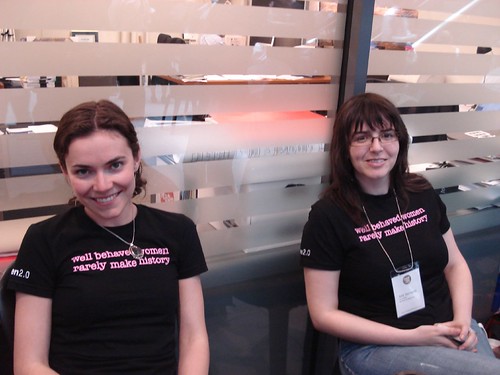
Mesh-y Reflections
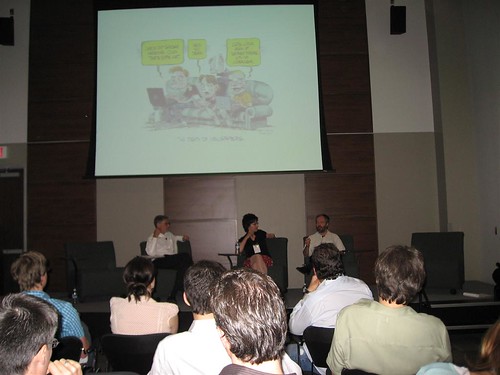
I really enjoyed myself at the mesh conference over the last two days. I found the sessions themselves to be a little on the light side compared to the world in which I’m used to playing, especially on the first day. On the other hand, the overwhelmingly positive feedback that I received for the session I did with Nora Young and Mark Schneider suggested that the audience is craving some sessions that are a little more deep and thought-provoking. The second day opening keynote conversations with Richard Edelman (Edelman) and Jim Buckmaster (Craigslist) demonstrated that people who offer a different and thoughtful perspective on what’s going on (that is, other than the typical and obvious-to-all Web 2.0 hype) will command this audience’s attention. (And, much to my delight, I found out that Craigslist is very much a valence organization).
I wish I had a recording of the session in which I participated. The theme was about media consumption, essentially asking the question about whether people today “graze” rather than dive deeply into the various media, and what this means for all sorts of different aspects of society. But we quickly moved on to the history of knowledge, authority and societal shifts (after all, I was on the panel :), collaborative production of media and culture, immersive, participatory entertainment (of which NBC’s Heroes is a great example of how a traditional consumptive medium is attempting to break out of its conventional hypnotic, hot medium, mode), and a bunch of other stuff that kept the packed room engaged for over the allotted hour.
 The best part of the conference for me was undoubtedly the conversations – the “meshing” – that took place. Not only did I have the opportunity to catch up with friends that I hadn’t seen for quite a while. I also had many engaging encounters with all sorts of interesting people across a wide array of topics. Particularly gratifying was the interest in my research and thesis work. Among new, would-be entrepreneurs and long-experienced and successful business people, A Valence Theory of Organization seemed to resonate well and just make sense, especially to those who are embodying and experiencing the importance of human networks to successful businesses today. For those with whom I did not have the opportunity to engage, and for others who might want a quick recap of my thesis pitch, here it is:
I make the observation that almost all organizations that we have in our world – be they business corporations, non-profits, volunteer organizations, sewing circles, soccer clubs, schools, religious organizations – they all look like factories. By this I mean that they are Bureaucratic, Administratively controlled and Hierarchical – in other words, BAH! I suggest that this is not because it is human nature to be BAH, but rather this is an artefact of the Industrial Age that was mechanistic (with roots in the Gutenberg Press), industrial, fragmented, and functionally oriented. Now, as I look around, I observe that we are no longer in the Industrial Age. Rather, we are living in a world in which everyone is, or soon will be, connected to everyone else – an age of ubiquitous connectivity. This brings about the effect of being immediately next to, or proximate to, everyone else – in other words, pervasive proximity. I therefore ask the question, what form of organization is consistent with the ubiquitously connected and pervasively proximate world of today, rather than with the 19th century?To Rob, who invited me to participate, and to Stewart, Matthew, Mark, and Mike – thanks for a great time!
My answer draws from a metaphor of the Bohr model of the atom, and especially the valence or connection level of electrons that are shared by a molecule when two or more atoms come together. I identify several specific forms of valence relationships that are enacted by two or more people when they come together to do almost anything; these are economic, social-psychological, identity, knowledge, and ecological. An organization is thus defined as that complex, emergent entity which occurs when two or more people, or two or more organizations, or both, share multiple valences at various strengths, with various pervasiveness, among the component elements. Using this as a definition of organization has profoundly disruptive implications for every aspect of management, governance, and engagement that we have come to know over the last hundred or so years. This vocabulary of Valence Theory (and its associated Theory of Effects) has the elegant appeal (among others) of being able to explain and account for all of our traditional organizations, as well as all the funky sorts of organizations that have appeared over the past decade.
[Technorati tags: mesh07 | valence theory | organization]
29 May 2007
A Response to Another Casualty of the School System
Joanna sent this response to my previous post by email, reproduced here with her permission:
[Technorati tags: k12 | high school | effective teachers | grading]
I keep on encountering this problem (as a teacher) underlying many effects in the institution I work for. I see the bureaucracy, administration and faculty, rearranging the deck chairs with alacrity but unable to look at the deeper problem. I feel deeply uncreative and useless in the face of it. It has something to do with self-organizing principles and finding a new way to see accomplishment, but how to fit that in to what already exists is beyond me.I'd love to hear your thoughts on this issue as well. Comments are open!
The terrible thing is, the student didn't play the game. The rules were either not explicit or not followed. This is what I tell my students, that by paying for this course they have signed up for a game in which the institution makes the rules, and I provide them with a checklist of the rules they need them to follow in order to get a good grade – down to one mark for the title, one mark for a topic sentence etc. In one course, I have the ability to get them to make the rules they will follow, but this course is under attack as not being academic enough (!)
The paradigm is parallel to all the other systems the school society is built on. If students do something else that shows great learning and real thought, I have limited flexibility on the grade I can assign because one of the institution's values is Consistency. Is this useful learning? Absolutely not. Rule-following is a skill made largely obsolete by computers. Yet it is the box I am logically forced into by my contract, the need to defend contested grades, and the general incomprehension of what I am talking about when I try to engage colleagues on the topic of working with the change in student’s worlds rather than against it.
What's next? I keep feeling that if I could just come up with some kind of vision of what the future might look like, I could steer a path toward it from here. What will people be paid for in the future? The ability to find answers and execute? Can we teach our students to connect to their own internal drive to discover answers, and can we come up with a better way for them to prove they can do it than grades and useless assignments? Would love to hear your thoughts, and I will continue to ponder it.
[Technorati tags: k12 | high school | effective teachers | grading]
28 May 2007
Another Casualty of the School System
A high school student that I know is the latest casualty of the school system. The student writes, "I give up. I've had it with this bullshit" in a final fit of frustration with one (actually several) of her subjects. (I am being deliberately vague here to protect both the guilty and the innocent.) This is not a marginal student, nor one at risk; this is an A student in the final year of high school. The student has been given a near-failing grade on a presentation assignment in which s/he discovered subtle and significant connections in the subject matter, presented them in an articulate, logical and well-prepared fashion, and engaged the class in a lively discussion of the issues for over twice as long as any other student had done (the other students who were to present that day apparently skipped the class, so this one filled the time since the teacher had nothing else prepared).
So why the bare pass on the assignment? Apparently (1) the student did not present the teacher's preconceptions about the subject, choosing instead to come up with original ideas, and (2) chose to use the bulk of the seminar time to facilitate a lively conversation after presenting a concise case for the ideas, rather than belabouring the point and filling up the time that way. The rubric for time stated that the seminar was to be 20 minutes. The student interpreted this to mean the entire seminar - including conversation; the teacher chose to interpret this to mean that the prepared material had to consume the 20 minutes, even though there was supposed to be some facilitation. There was apparently no explicit, pre-defined division of time, yet the student was penalized for half the presentation being "missing." Additionally, the rubric scores for articulate presentation, logical flow of ideas, and preparation were each penalized by half the total value since the teacher claimed that she could not know whether the "missing" prepared material would have been equally articulate, logical, and well-prepared. And, there was no consideration given for quality of facilitation, engagement, and the fact that the student saved the teacher's butt by keeping the class actively engaged throughout the period.
As I said, this is a student who used to love school, and love literature (actually, still does - reads complex and sophisticated authors without having to worry about ridiculous content tests - who said what to whom) but now has become allergic to both in the academic setting. I know this student's parents, and they have been actively engaged throughout the schooling of both their children.
To me, this is another sad case of a burnt-out, small-minded teacher conveying the well-rehearsed lesson that school is the place in which a love of learning and the value of curiosity, discovery and insightful, abstract thought are to be trampled beyond recognition. These are substituted instead by a discipline that enforces compliance, conformity, and intellectual docility, rewarding the mediocre to create a compliant, easily distracted citizenry for the benefit of the elites.
Having had two children go through the public education system from start to finish (both relatively successfully), I have seen more than my fair share of teachers that could use an intellectual refresher. Once upon a time, this was the purpose of Professional Activity days. But even when spent in professional development seminars, there is not the time to engage in the types of activities that can effect revitalizing transformation. I think it's time that we considered paid mid-career sabbaticals for K-12 teachers for them to take a mandatory year at a faculty of education, studying, perhaps among other things, critical pedagogy and contemporary methods for engaging with their students. Because this is for the health and welfare of the teachers (not to mention their students) I think it could quite reasonably be funded out of the vast wealth of the teachers' pension fund. (As an aside, the traditional BAH/dialectic approach would be against this funding proposal, whereas a Valence Theory approach would find this to be an optimal solution for all concerned.)
Why do some teachers end up being ridiculed on students' Facebook walls? What would drive a student to be so disrespectful, sometimes to the point of defamation? What causes school morale problems that lead to teachers and administrators being mocked? Students are not born hating school and believing it is irrelevant to their lives. Those lessons are well taught.
[Technorati tags: K12 | high school | effective teachers | grading]
So why the bare pass on the assignment? Apparently (1) the student did not present the teacher's preconceptions about the subject, choosing instead to come up with original ideas, and (2) chose to use the bulk of the seminar time to facilitate a lively conversation after presenting a concise case for the ideas, rather than belabouring the point and filling up the time that way. The rubric for time stated that the seminar was to be 20 minutes. The student interpreted this to mean the entire seminar - including conversation; the teacher chose to interpret this to mean that the prepared material had to consume the 20 minutes, even though there was supposed to be some facilitation. There was apparently no explicit, pre-defined division of time, yet the student was penalized for half the presentation being "missing." Additionally, the rubric scores for articulate presentation, logical flow of ideas, and preparation were each penalized by half the total value since the teacher claimed that she could not know whether the "missing" prepared material would have been equally articulate, logical, and well-prepared. And, there was no consideration given for quality of facilitation, engagement, and the fact that the student saved the teacher's butt by keeping the class actively engaged throughout the period.
As I said, this is a student who used to love school, and love literature (actually, still does - reads complex and sophisticated authors without having to worry about ridiculous content tests - who said what to whom) but now has become allergic to both in the academic setting. I know this student's parents, and they have been actively engaged throughout the schooling of both their children.
To me, this is another sad case of a burnt-out, small-minded teacher conveying the well-rehearsed lesson that school is the place in which a love of learning and the value of curiosity, discovery and insightful, abstract thought are to be trampled beyond recognition. These are substituted instead by a discipline that enforces compliance, conformity, and intellectual docility, rewarding the mediocre to create a compliant, easily distracted citizenry for the benefit of the elites.
Having had two children go through the public education system from start to finish (both relatively successfully), I have seen more than my fair share of teachers that could use an intellectual refresher. Once upon a time, this was the purpose of Professional Activity days. But even when spent in professional development seminars, there is not the time to engage in the types of activities that can effect revitalizing transformation. I think it's time that we considered paid mid-career sabbaticals for K-12 teachers for them to take a mandatory year at a faculty of education, studying, perhaps among other things, critical pedagogy and contemporary methods for engaging with their students. Because this is for the health and welfare of the teachers (not to mention their students) I think it could quite reasonably be funded out of the vast wealth of the teachers' pension fund. (As an aside, the traditional BAH/dialectic approach would be against this funding proposal, whereas a Valence Theory approach would find this to be an optimal solution for all concerned.)
Why do some teachers end up being ridiculed on students' Facebook walls? What would drive a student to be so disrespectful, sometimes to the point of defamation? What causes school morale problems that lead to teachers and administrators being mocked? Students are not born hating school and believing it is irrelevant to their lives. Those lessons are well taught.
[Technorati tags: K12 | high school | effective teachers | grading]
The Lives of Others
I saw a great movie over the weekend, The Lives of Others, or as it is originally titled in German, Das Leben der Anderen. It is truly a superb movie about life in the former GDR (East Germany) just prior to the fall of the Berlin Wall. It depicts the intimidating power of a state with an information and control fetish via the state secret police, or Stasi.
Every aspect of this film, from writing and directing, through acting and editing, are superb. It captures the look and feel of the era, from the 1950s-drab architecture (even though the story is set - ironically - in 1984) to the 1950s-drab Stasi officials. The "subversive" artists and intelligensia feel more contemporary, trapped in the time warp, resisting their subjugation through life-affirming art, music, acting and sex (the comparison made especially stark when contrasted with the main Stasi protagonist, Weisler's, perfunctory engagement with a prostitute).
What struck me, though, was the unavoidable comparison with contemporary nation-states that share an extreme information and control fetish with the now long-gone East German Stasi. Enemies of the state and the state ideology are everywhere. The state must be protected, and the way to accomplish this is through knowing everything about a person that can possibly be known. This movie illustrates what can happen to otherwise innocent people when those in power have arbitrary access to such information, or the power to pry into the lives of others without oversight or accountability.
[Technorati tags: the lives of others | das leben der anderen | stasi]
Every aspect of this film, from writing and directing, through acting and editing, are superb. It captures the look and feel of the era, from the 1950s-drab architecture (even though the story is set - ironically - in 1984) to the 1950s-drab Stasi officials. The "subversive" artists and intelligensia feel more contemporary, trapped in the time warp, resisting their subjugation through life-affirming art, music, acting and sex (the comparison made especially stark when contrasted with the main Stasi protagonist, Weisler's, perfunctory engagement with a prostitute).
What struck me, though, was the unavoidable comparison with contemporary nation-states that share an extreme information and control fetish with the now long-gone East German Stasi. Enemies of the state and the state ideology are everywhere. The state must be protected, and the way to accomplish this is through knowing everything about a person that can possibly be known. This movie illustrates what can happen to otherwise innocent people when those in power have arbitrary access to such information, or the power to pry into the lives of others without oversight or accountability.
[Technorati tags: the lives of others | das leben der anderen | stasi]
25 May 2007
I'm Going to mesh
I've been invited to participate on a panel at next week's mesh conference, being held at the MaRS Collaboration Centre on May 30 and 31. mesh is
The week after mesh, I'm off to the CASAE conference in Halifax, giving a roundtable session on cyber-education. After CASAE, it's a keynote in Edmonton for SEARCH Canada (formerly the Alberta Heritage Foundation for Medical Research) on why evidence-based research is no longer sufficient to answer the question, How Do We Know?
[Technorati tags: mesh conference]
Canada's premier Web conference, being held in Toronto on May 30th & 31st, 2007, is a chance to connect with people who are as excited about the potential of the Web as you are – people who want to know more about how it is changing the way we live, work and interact with the world. The evolution of the Web as a social medium is dismantling old business models, but it is also creating new ways for us to communicate, collaborate, entertain and inform. At mesh, you will hear from people who are using these tools in creative ways. We believe that by connecting and sharing our ideas, we can help inspire each other to do something great, whether it's running a startup or building a community.I'll be on a panel at 14:30 on the first afternoon with Nora Young, Mark Schneider, and moderated by Rob Hyndman. We'll be discussing Digital Blinders - Are We an Inch Wide and a Mile Deep?. As Rob describes the theme,
What I'm hoping for is a broad ranging discussion of how the Web is changing the way we consume media. One of the criticisms often levelled at social media in particular is that it's shallow - brief snippets of information or experience, covering a wide swatch of human experience. Is the age of deeper understanding, of careful analysis, of diligently researched reporting ... over?If you're attending the conference (it's now sold out, apparently), please stop by the panel session and participate in the conversation. I always love to meet the folks who wander by my musings. And, I'm looking forward to meeting some folks with whom I've spoken, or whose blogs I've read, but haven't yet had the opportunity to engage in physical presence.
The week after mesh, I'm off to the CASAE conference in Halifax, giving a roundtable session on cyber-education. After CASAE, it's a keynote in Edmonton for SEARCH Canada (formerly the Alberta Heritage Foundation for Medical Research) on why evidence-based research is no longer sufficient to answer the question, How Do We Know?
[Technorati tags: mesh conference]
20 May 2007
Fair-y Use Tale
A tremendous explanation of copyright and fair use (which is the U.S. construct - Canadian fair dealing is different) done through fair use snippets from Disney films. This work was done by the Stanford Center for Internet and Society, which has a link to the mp4 version.
[Technorati tags: copyright | fair use | fair-y use tale]
Professor Eric Faden of Bucknell University provides this humorous, yet informative, review of copyright principles delivered through the words of the very folks we can thank for nearly endless copyright terms.The YouTube version is here:
[Technorati tags: copyright | fair use | fair-y use tale]
18 May 2007
This is Surreal
What's My Line was a television game show that was popular in the 1950s and 1960s in which a panel attempted to guess the profession of the guests. Occasionally, a well-known mystery guest would appear on the show. This appearance of Salvador Dali is priceless, and yes, almost surreal.
[Technorati tags: salvador dali | what's my line | classic television]
[Technorati tags: salvador dali | what's my line | classic television]
13 May 2007
Amazing Colour Changing Card Trick
A perfect example of "what haven't you noticed lately?" Watch this video carefully for the point at which the colour changes.
[Technorati tags: colour changing card trick | awareness]
[Technorati tags: colour changing card trick | awareness]
09 May 2007
The Dubious Long Arm of the... Well Whose Law Is It?
Pervasive proximity in action. A rather disturbing story from down under, in which a man
[Technorati tags: australia | extradition | copyright | hew griffiths | extraterritoriality]
was extradited to the United States; Hew Griffiths, from Berkeley Vale in New South Wales, had never even set foot in America. But he had pirated software produced by American companies. Now, having been given up to the US ... Griffiths, 44, is in a Virginia cell, facing up to 10 years in an American prison after a guilty plea late last month.I can understand extraditing someone accused of committing a criminal offence on the physical territory of the requesting country. What I find truly frightening is the stance of extraterritoriality that the United States now assumes. As the Australian legal community now considers the implications of the pro-Bush, Howard government's decision,
NSW Chief Judge in Equity, Peter Young, writes: "International copyright violations are a great problem. However, there is also the consideration that a country must protect its nationals from being removed from their homeland to a foreign country merely because the commercial interests of that foreign country are claimed to have been affected by the person's behaviour in Australia and the foreign country can exercise influence over Australia."This action, of course, is the logical extension of the United States policy of extraordinary rendition. And when anything is pushed beyond the limit of its capacity, it tends to reverse what were its initial effects. So what are the reversal aspects of law enforcement?
[Technorati tags: australia | extradition | copyright | hew griffiths | extraterritoriality]
08 May 2007
Introducing Schoopy: Online K-12 Classroom
Last evening I was the guest on the Legal Briefs call-in show about Facebook. Some of the recurrent themes that callers tended to raise included how students should be instructed about appropriate online behaviour, who should do that instruction, and how parents can become both more knowledgeable and more involved in their children's online engagement. At one point in the conversation, I called out for a teacher brave enough to create an online space of engagement that would involve the teacher, her students, and the parents, all collaborating with respect to classroom activities. The classroom would, in effect, extend into and include the home.
Coincidentally, this afternoon, I met with Nico Rowinsky (who is a middle school classroom teacher) and Tim Didn't-Catch-His-Last-Name (a very common surname, as it turns out) from Schoopy, an online environment specifically designed for the K-12 classroom, that provides the ease and flexibility of a social networking environment like Facebook, without many of the lack-of-controls that give some classroom teachers - and lots of parents - the willies.
Their approach is to create a relatively closed environment in which younger students can experience online engagement like online peer editing and review, collaboration on both homework and projects, and learn about appropriate behaviours, while parents can keep track of homework, announcements, long-term assignments and events. Teachers can be available after hours to provide the key suggestion which makes the difference between homework getting done or not (and encourage peer support), and lessons can be reviewed by parents who would be able to double-check the "no homework tonight, dad" claim. In fact, Nico told me of one grateful student who said that "Schoopy saved my butt" when he realized that he had left the weekend homework assignment in his locker late one Friday, but was able to download it from his classroom Schoopy site.
So far, this isn't particularly special, although it is tremendously worthwhile and something that I've been advocating for many years now. What's cool about Schoopy is its ability to expand the topology of what constitutes a classroom. Within a secure, easy-to-use, non-geek environment, teachers can link classrooms from diverse locations to create collaborations that augment the lessons being taught. Imagine linking up a classroom in St. John's with one in Vancouver to do joint projects on the building of the Canadian Pacific Railway. Or connecting urban and rural classrooms, or classrooms in the north with those in the south to study a unit on climate, or cross-cultural education.
With a new software release due out imminently that apparently opens up many so-called web 2.0 features, the team behind Schoopy are now planning to turn their attention to offering specific curriculum-augmenting applications for the various grade divisions from K to 12. To the best of my knowledge, Schoopy is free for (at least) the first school in a school board as a local pilot.
[Technorati tags: schoopy | online classroom | parent teacher involvement]
Coincidentally, this afternoon, I met with Nico Rowinsky (who is a middle school classroom teacher) and Tim Didn't-Catch-His-Last-Name (a very common surname, as it turns out) from Schoopy, an online environment specifically designed for the K-12 classroom, that provides the ease and flexibility of a social networking environment like Facebook, without many of the lack-of-controls that give some classroom teachers - and lots of parents - the willies.
Their approach is to create a relatively closed environment in which younger students can experience online engagement like online peer editing and review, collaboration on both homework and projects, and learn about appropriate behaviours, while parents can keep track of homework, announcements, long-term assignments and events. Teachers can be available after hours to provide the key suggestion which makes the difference between homework getting done or not (and encourage peer support), and lessons can be reviewed by parents who would be able to double-check the "no homework tonight, dad" claim. In fact, Nico told me of one grateful student who said that "Schoopy saved my butt" when he realized that he had left the weekend homework assignment in his locker late one Friday, but was able to download it from his classroom Schoopy site.
So far, this isn't particularly special, although it is tremendously worthwhile and something that I've been advocating for many years now. What's cool about Schoopy is its ability to expand the topology of what constitutes a classroom. Within a secure, easy-to-use, non-geek environment, teachers can link classrooms from diverse locations to create collaborations that augment the lessons being taught. Imagine linking up a classroom in St. John's with one in Vancouver to do joint projects on the building of the Canadian Pacific Railway. Or connecting urban and rural classrooms, or classrooms in the north with those in the south to study a unit on climate, or cross-cultural education.
With a new software release due out imminently that apparently opens up many so-called web 2.0 features, the team behind Schoopy are now planning to turn their attention to offering specific curriculum-augmenting applications for the various grade divisions from K to 12. To the best of my knowledge, Schoopy is free for (at least) the first school in a school board as a local pilot.
[Technorati tags: schoopy | online classroom | parent teacher involvement]
07 May 2007
Psych Survivors Get Star Treatment
The Coalition Against Psychiatric Assault gets "Star" treatment from the Toronto Star, with an article describing the effects of electroshock (ECT or electroconvulsive therapy) on women:
Personally, I find Dr. Goldbloom's comments disingenuous. I am close to a family who has rescued - and I do not use that term lightly - one of their loved ones from CAMH's electroshock within the last two months. The patriarch of the family, a man in his early 70s, had been diagnosed with cancer and became depressed during treatment - not an atypical response. He was whisked to CAMH, placed on drugs, and in less than a week was coerced into electroshock treatment. Neither he nor his family were informed about the side effects. And, when he asked about psycho-therapy as an alternative he was explicitly told that he would not be allowed to have psycho-therapy, nor would he ever be discharged, unless he agreed to electroshock. After several horrifying treatments, after which he was traumatized and terrified, he attempted to withdraw his consent. He was immediately declared incompetent so that the doctors could continue to administer shock. Fortunately, he had the opportunity to transfer power of attorney for personal care to his wife mere moments before the doctor's unilateral declaration. This enabled his family to remove him from CAMH's jurisdiction, take him to a hospital outside of Toronto, where both his cancer and depression are being well looked after - the latter with caring and supportive psycho-therapy, and relatively light medication.
If you or a loved one is being asked (or told) to consider electroconvulsive therapy (ECT) for the treatment of depression, you would do well to read through some of the materials provided by CAPA, and especially this post on their weblog about authentic informed consent.
Disclosure: I volunteer with CAPA.
[Technorati tags: ECT | electroconvulsive therapy | electroshock | capa | coalition against psychiatric assault | bonnie burstow]
Young women struggling with new babies and elderly women are the two groups of patients most commonly prescribed this therapy, says [Dr. Bonnie] Burstow [professor of Adult Education and Counselling Psychology at OISE/UT]. That is why the coalition is organizing its rally for Mother's Day under the slogan, "Stop shocking our mothers and grandmothers."There is also what sounds like the standard psychiatric line from Dr. David Goldbloom at CAMH in Toronto, Canada's leading venue for electroshock. He claims, "the treatment at his institution is used for those with moderate to severe depression where drugs or other therapies haven't worked or are not advised. "ECT is not typically a first line of response.""
Burstow's study of ECT from a feminist perspective, "Electroshock as a Form of Violence Against Women," has appeared in the U.S. publication Journal of Violence Against Women. "It's a form of head injury," she says. "Doing nothing is better than doing something that harms them." Burstow acknowledges that most people believe ECT has been discontinued, although roughly 2,000 people each year receive it in Ontario hospitals.
Personally, I find Dr. Goldbloom's comments disingenuous. I am close to a family who has rescued - and I do not use that term lightly - one of their loved ones from CAMH's electroshock within the last two months. The patriarch of the family, a man in his early 70s, had been diagnosed with cancer and became depressed during treatment - not an atypical response. He was whisked to CAMH, placed on drugs, and in less than a week was coerced into electroshock treatment. Neither he nor his family were informed about the side effects. And, when he asked about psycho-therapy as an alternative he was explicitly told that he would not be allowed to have psycho-therapy, nor would he ever be discharged, unless he agreed to electroshock. After several horrifying treatments, after which he was traumatized and terrified, he attempted to withdraw his consent. He was immediately declared incompetent so that the doctors could continue to administer shock. Fortunately, he had the opportunity to transfer power of attorney for personal care to his wife mere moments before the doctor's unilateral declaration. This enabled his family to remove him from CAMH's jurisdiction, take him to a hospital outside of Toronto, where both his cancer and depression are being well looked after - the latter with caring and supportive psycho-therapy, and relatively light medication.
If you or a loved one is being asked (or told) to consider electroconvulsive therapy (ECT) for the treatment of depression, you would do well to read through some of the materials provided by CAPA, and especially this post on their weblog about authentic informed consent.
Disclosure: I volunteer with CAPA.
[Technorati tags: ECT | electroconvulsive therapy | electroshock | capa | coalition against psychiatric assault | bonnie burstow]
Paging Jon Stewart
This story about Canadian nano-spy-technology embedded in our coinage is right up your alley. Pssst... Tim Hortons* is really a franchised, super-duper-sekrit spy supply shop. Those sprinkles on the vanilla dips are really miniature spycams... or listening devices... or biological agents...
*the coins were originally distributed through Timmie's locations
[Technorati tags: poppy coin | canada | quarter | paranoia]
*the coins were originally distributed through Timmie's locations
[Technorati tags: poppy coin | canada | quarter | paranoia]
03 May 2007
News Flash: Ontario Bureaucracy Filled With Old Fogeys... Film at 11
Actually, at 5:30, or thereabouts. I did a short interview with Global National today about the Ontario Government's decision to block access to Facebook by MPPs and civil servants. Premier Dalton McGuinty can perhaps be excused as being a member of the fogey generation that just doesn't get the effects of the UCaPP world. Or perhaps he's just not in favour of increasing direct connectivity to the various constituencies served by the government. After all, with larger and more complex networks of relationships, it's increasingly difficult to maintain control, especially in political situations.
The nominal reason is that government workers should be working, and not wasting time and taxpayers' money playing on their computers. Reaching out and connecting, especially via the fastest growing social networking capability (and Toronto apparently has the largest population of Facebook participants of any city in the world) isn't on the government agenda. Instead it appears to bureaucrats as something that kids play on constantly, their noses to screen, waiting compulsively for the next message to appear.
And then there's the Blackberry...
[Technorati tags: ontario government | dalton mcguinty | facebook]
The nominal reason is that government workers should be working, and not wasting time and taxpayers' money playing on their computers. Reaching out and connecting, especially via the fastest growing social networking capability (and Toronto apparently has the largest population of Facebook participants of any city in the world) isn't on the government agenda. Instead it appears to bureaucrats as something that kids play on constantly, their noses to screen, waiting compulsively for the next message to appear.
And then there's the Blackberry...
[Technorati tags: ontario government | dalton mcguinty | facebook]
Well, I Spoke Too Soon...
During my Generation Gap talk a couple of weeks ago, I mentioned the difference between the Hillary Clinton and Barack Obama campaigns with respect to using current technologies. The Clinton campaign seemed to be more of the same broadcast politics that we have known and (not) loved since the Kennedy-Nixon debate, in which a small group controls the campaign's message, and casts it broadly to the public. In contrast, the Obama campaign felt far more UCaPP-y, with enthusiastic volunteers collectively building Obama's identity via social networking environments like MySpace.
Well, it seems like the bloom is off the online rose, as the Obama campaign has moved to take top-down control of the volunteer-created Obama MySpace page, along with its 160,000 enthusiastic "friends." The result has been devastating: "Yesterday, the profile had just over 160,000 friends. Today, that url has only about 12,000. And it's under new ownership. Joe Anthony, one of the super volunteers of the Connected Age, has lost control of the page he started to the professionals on Obama's staff."
As details of the tale emerge, there is an air of sordidness to the mess, with accusations of extortion and deceipt flying back and forth. However, the key questions that Micah Sifry surfaces are perhaps the most important aspect of this growing debacle:
[Technorati tags: barack obama | myspace | ucapp | valence theory]
Well, it seems like the bloom is off the online rose, as the Obama campaign has moved to take top-down control of the volunteer-created Obama MySpace page, along with its 160,000 enthusiastic "friends." The result has been devastating: "Yesterday, the profile had just over 160,000 friends. Today, that url has only about 12,000. And it's under new ownership. Joe Anthony, one of the super volunteers of the Connected Age, has lost control of the page he started to the professionals on Obama's staff."
As details of the tale emerge, there is an air of sordidness to the mess, with accusations of extortion and deceipt flying back and forth. However, the key questions that Micah Sifry surfaces are perhaps the most important aspect of this growing debacle:
Is it true that once a voter-generated site gets major traction, the campaign affected has to control it? Can a front-running presidential campaign--even one as devoted to empowering supporters to take their own initiatives and connect to each other through social network tools as the Obama campaign--afford a major site run by a campaign volunteer outside their control? Is such control even possible?Indeed. One of the attributes of UCaPP effects is the inability to conventionally control the emergent, complex entity that is the resultant valence political organization. This raises the interesting question: what happens when you put BAH controls on a valence organization? What desirable effects are precluded in the name of control and formal structure?
The most intriguing thing about this whole mess is this is the first time I can think of where the grass-roots activist at the bottom of the pile has a megaphone as big as the folks who tried to boss him around.
[Technorati tags: barack obama | myspace | ucapp | valence theory]
Subscribe to:
Posts (Atom)