29 July 2009

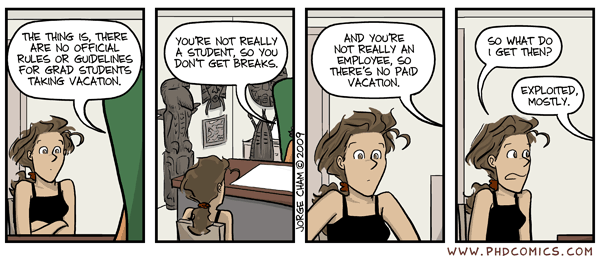
To Everyone Who Has Asked Me, "Are you getting away this summer?"


Thanks, PhD Comics!

[Technorati tags: | ]

The Power When Pressed

At the funeral of the late Canadian governor-general, Roméo LeBlanc, Prime Minister Stephen Harper received the communion wafer - known to Catholics as The Host, representing the body of Christ - and appears to have palmed it, rather than consuming it. To Catholics, this is scandalous, and it created a controversy at the time.


What Harper, a Protestant, was doing receiving communion is quite another matter. However, yesterday, the New Brunswick Telegraph Journal issued an apology for publishing the story, and its publisher stepped down:
James Irving, the scion of the Irving family who chose journalism over the traditional strongholds of oil refineries and pulp mills has left his position as publisher of the New Brunswick Telegraph Journal. This came as the newspaper offered an apology to Stephen Harper and two of its reporters for factual errors inserted into a story that accused the Prime Minister of pocketing a communion wafer at a funeral mass earlier this month for former governor-general Roméo LeBlanc. The apology, published on the front page of Tuesday's paper and on its website, said the wafer story was “inaccurate and should not have been published.”
Given that the Irving family owns lumber, ship building, oil and liquid natural gas refining, TV stations, and newspapers - most of which can be given quite a hard time by the federal government of the day - the fact that this apology and resignation came in response to a clearly embarrassing faux pas by the Prime Minister is perhaps a bigger scandal than the original scandal.

It is far easier and more palatable to excuse Prime Minister Harper his ignorance of religious protocol, or his discomfort with being in the wrong place - the communion line - at the wrong time (he seems to have a predilection for this, doesn't he?) than it is to believe that this recent publisher's mea culpa was freely given. Is it possible that political pressure was exerted to "correct" the record, effectively rewriting the history of the event in question? If so, it sets a very dangerous precedent and gives yet another indication of the true character of Stephen Harper.

Somehow, it seems to me that three Hail Marys and four Our Fathers won't quite cut it this time.

[Technorati tags: | | | ]

28 July 2009

EMD XIII: So What’s This Empowerment All About, Anyway?

If you have arrived at this post directly, and are not familiar with my research, you may want to also visit some of the posts under the Valence Theory and Thesis labels, as well as reading the very quick primer.

Being empowered rests on the individual ability to take autonomous action based on independent, sometimes disagreeing, but aligned thought, among a group of autonomous actors. As one participant from a UCaPP organization puts it, “having a lot of people working on the same thing at the same time. Going in approximately in the same direction, but also, bringing many, many different perspectives. Many heads are better than one when you’re looking at this sort of thing. And actually, many kinds of voices, many ways of expressing things. Divergent views at times are all things that are important to have when you’re trying to achieve objectives around many of the things we work on.”

Part of empowerment – the major part of enabling true empowerment in an organization – is the acceptance that people can sometimes make a bad decision, and that the organization will support them, even if it means the decision must be retracted in a public forum. “While I know that I have the right and responsibility to do these things while I’m out, I also have the responsibility to ensure that I’m right. That I get is as right as I can. And understand my organization as well as I can, so that I can think about what the fallout might be. Whether it’s fallout in terms of, was that a very effective thing to do, to, did it undermine something else that we’re trying to do? Then, when I come back to the institution, it’s the institution’s obligation to support me. And, if there is fallout, if there’s a problem, even if they think I was wrong, but support me, and be able to figure out, okay, now what do we do? How do we manage this?”

Enabling this sort of autonomy and agency requires collaborative engagement in the analysis of issues, but not merely to make individual decisions. Rather, the collaborative process allows individual members to understand the collective mind of the organization itself, to be able to anticipate, for the most part, how any particular decision would be made. “When we’re here around the table, we do our analysis together. We understand our institution, we understand where we’re coming from. When we engage in the conversations, we understand it better and better. That allows us to go out and be the executive director, each and every one of us. We can make decisions for our organization.” This essentially means that no one individual or small sub-group of individuals has control; control is divested to the organization as a whole. The processes of developing the common understanding and sense-making that enable this divestiture create organization-ba and in doing so, enable individual autonomy and agency in the context of collective responsibility and mutual accountability; in other words, the elusive state of empowerment.

Characteristic of UCaPP organizations, collaborative leadership and individual empowerment in this sense does not suggest the absence of responsibility or accountability. It is quite the opposite, in fact. “We are responsible for the organization, and we’re all accountable to the organization. And, we all get benefit from the organization. So we work on the principle of parity. Parity of responsibility, accountability, obligation, as well as parity of what we get out of the organization. … Because it’s a matter of judgement, you just have to develop your judgement. And, it’s also a matter of trusting the [other] person’s judgement. There’s no procedure manual sort of thing that you can say, okay, your judgement goes 75% of the time and then you have to bring it. There’s no quantitative way to do that.”


[Technorati tags: | | | | ]

EMD XII: More on the Environment of Empowerment

If you have arrived at this post directly, and are not familiar with my research, you may want to also visit some of the posts under the Valence Theory and Thesis labels, as well as reading the very quick primer.

Empowerment cannot exist in an environment where there is not a conscious and explicit reflection on power relations. It cannot exist in an environment in which the natural power dynamics of knowledge-based authority, or particular subject-matter expertise becomes entrenched in an arbitrarily constructed, normatively imposed, hierarchical internal structure. In other words, the members of a BAH organization cannot enjoy individual empowerment, irrespective of the rhetoric or euphemisms.

In traditional, more-BAH organizations, people often claim empowerment when they can speak their minds and feel they have been heard, and when they can act without feeling they need to seek prior permission. But when one looks behind the curtain, as it were, there remains the question of how that consultation is actually considered, and whether the apparently autonomous action was taken within previously delineated-by-policy “guidelines.” Are people being authentically consulted in an attempt to make sense of a complex situation through inviting diverse voices? Or, is the consultation really an exercise in making those whose opinions are consistent with that of legitimated leaders feel included while simultaneously ferreting out dissenters for more focused attention?

In a BAH organization, decisions made by those with legitimate power, relatively higher in the hierarchy, can be disseminated throughout the organization with little need to convince the other members of the organization. Coercive influences is sufficient to ensure compliance. In a relatively more contemporary organization that seems to espouse UCaPP principles but is struggling with BAH isomorphism as it grows, the act of “convincing someone” of the leader’s vision being the correct one might be a sign of in-use theory separating from espoused theory in what is nominally collaborative decision making, but in fact is the legitimate leader increasingly exerting his will. As one individual puts it, “I spend time with our CEO and he’ll tell me how he wants it, and I’ll pretty much write down what he wants and I will work with that.” Espoused “democracy” in decision-making is considered great, so long as everyone is in agreement. Any differing opinions signal involvement by the CEO to either bring dissenters in line. He describes it like this: “There will be disagreement, and I will invest time in that individual to help describe to them where I’m coming from, and usually once they get themselves into the set of shoes I need them to be in, it’s usually a lot easier to convince them that, in fact, this is what we need to do.”

On the other hand, in a UCaPP organization, decisions that are not unanimous will cycle back through the collaborative decision-making process for maintains a legitimated power structure via a nominal hierarchy, those higher up must make a specific and deliberate effort to ensure that they are honestly listening to, and truly considering, opinions and situation analyses that differ from their own. Polarity management, dialogue and other similar mechanisms are very important to ensure that the legitimate leader is consulting, not convincing.

The key element here in dealing with dissenting opinion is that power and control to impose one’s view does not occur in a UCaPP organization. The most that an individual can accomplish is to reopen an issue for further consideration and reflection. However, there is the implicit trust in the fact that for controversial topics, there is “the opportunity to talk about things more than once naturally on their own.” This illustrates another contrast with a more-BAH organization: the leader's power is exercised to prevent controversial issues from being raised again (effectively precluding questioning of the power that pushed it through in the first place). The CEO to whom I referred earlier frames it this way: “you can disagree about stuff, but then once you decide to commit to it, you commit to it and you don’t look back.”

[Technorati tags: | | ]

EMD XI: Enabling Environments of Empowerment

If you have arrived at this post directly, and are not familiar with my research, you may want to also visit some of the posts under the Valence Theory and Thesis labels, as well as reading the very quick primer.

Let me state right off the top that I hate the word empowerment. It is one of those words that brings along as much baggage and false expectations as meeting up again with your freshman boy/girlfriend years after you’ve graduated. (Don’t like that metaphor? I’ve got others!) On one hand, empowerment may indeed convey the notion of individual autonomy and agency that is a hallmark of the UCaPP organization. On the other, the notion of empowerment – that often accompanies its sister ideas of participatory or democratic management – may often prove to be an exercise in behaviour modification that increases one’s sense of responsibility and accountability without the concomitant conveyance of authority to act without having to first check with either a superior, policy, or procedure. This post and the next reflects on issues surrounding empowerment in both BAH and UCaPP contexts.

One of my participant organizations provides a great case study as it began as an entrepreneurship – a start-up, technology service organization – and doubled in size from about a dozen to two dozen people through the course of my study. It also, in my estimation, transitioned from being a more-UCaPP to becoming quite a bit more-BAH during the nine month period between the first and last conversations there. During the first round of conversations, there is specific mention of those who take support calls being able to effect remedial application changes very quickly, and that everyone is empowered to help customers. These dynamics are consistent with UCaPP behaviours in an environment with strong organization-ba, that is, everyone knowing what to do so that organizational impetus is emergent, yet consistent towards common effect. In contrast, by the time of the second conversation nine months later, customer support has evolved to become more BAH in its realization, with a relatively lower status, dedicated support group, and far less direct empowerment of individuals to fix problems in favour of a mediating administrative system. As well, there seems to be less direct involvement of more senior organization members in the overall support and satisfaction processes, resulting in less successful direct connections with customers.

One of the explanations for the changes that were related by this organization’s participants is that as the organization grew, it became important for role definition to solidify. A rapidly scaling organization cannot manage itself without devolving into confusion and chaos if everyone does everything: clear roles and responsibilities are imperative to maintain stability and to grow the organization and its service offerings. However, we must be careful not to conflate defined roles and functional areas of content expertise, with hierarchy and privilege if the organization truly wants to maintain a UCaPP context, as this organization nominally espouses. Unlike a BAH environment in which certain roles and certain subject matter expertise carry with them the connotations of power, class, and privilege, a UCaPP environment does not automatically assume, for instance, that organizational infrastructure roles (i.e., management functions) are mutually exclusive from functional content roles and are, by definition, worthy of a higher status and class privilege.

Start-up organizations often operate with more UCaPP-like characteristics, often by default, having limited numbers of participants who assume equal, “early joiner” status among themselves. The UCaPP-enabling environment often emerges from a phenomenon that I call founders-ba or entrepreneurial-ba that can be linked to charisma, an inspirational vision, referent leadership, and a powerful competitive zeal and energy. These factors create the common sense of purpose and volition to action that characterizes basho in an organization. As this nascent organization grows into a small company over its initial few years, the organization can either develop a more sustainable culture of organization-ba, enabling it to become a true UCaPP organization, or – as is far more often the case – it can evolve into a traditional BAH organization, the form to which most people have been socialized. What I observed in this organization as it transformed from start-up to small company is that individual autonomy and agency, and collaborative, highly participatory decision-making, gave way first to an informal status hierarchy (primarily based on accredited knowledge and experience), leading to a formal hierarchy and minimal bureaucracy, ending up well on the way to becoming a full-fledged BAH organization of about two-dozen people in which fully one-third of the entire staff complement has management titles, and decisions are made within an exclusive steering committee.

There is a key lesson illustrated here in how to grow the less formalized aspects of organizational roles and structures that characterize an entrepreneurship, while not digressing into anarchy: true empowerment in a UCaPP context means those who would otherwise end up on top in a traditional hierarchy must give up the privilege that accompanies legitimated power, and that runs contrary to the entrepreneur’s mindset of ownership and retaining absolute power and control. In a more-UCaPP organization, legitimated power changes to become predominantly nominal power, with power-connoting roles and titles primarily used for external consumption as in the case of two participant UCaPP organizations, one of which use the titles Director for everyone in their newest division, the other, Co-Manager for everyone in their organization.

As one might expect, referent power, rather than legitimate or coercive power, is more important and most potent in these environments, especially when considered in terms of valence contexts (i.e., the ba-aspect of each valence, depending on the situation, and which valence(s) become more relevant to the situation). However, problems develop when the founder/leader is either unwilling, unable, or both to relinquish legitimate and coercive power. I read this as an issue directly related to the Identity-valence relationship: does the founder/leader consider her/his role as truly enabling an environment of full participation, information sharing, and ceding of control in favour of inviting heterogeneous voices and dissenting opinions to the table? Or, does the founder/leader create a palliative construct that maintains elite control of the organization while nominally enabling dissenting voices to come forward for the purpose of being identified and “convinced” of the correctness of the leaders’ vision?

I cannot help but compare the CEOs of two of my participant organizations, one transforming from the more-UCaPP start-up to a more-BAH small company, and the other several years into a BAH to UCaPP transformation. Both of these leaders have, and can exercise an absolute veto and unilateral decision power with respect to members of their organizations and organizational direction. The key differences lie the intent and actions of each leader relative to creating systems of authentic collaboration (or not), enabling mechanisms that tend to divest absolute power rather than concentrating it in a privileged group, and encouraging a culture of inquiry rather than a culture of advocacy for the leader’s point of view. The latter CEO (of the UCaPP organization) reserves her veto and laments having to use it. She operates in a context of checking-in, continually seeking “for the sake of why” something is being done. The CEO of the former organization sees the veto as his legitimate right as the founder of the organization. He checks-up, using enquiry to identify dissenters – those who would question his direction and decisions – in order to convince them of the correctness of his vision. As one participant from that organization observes: “The organization has not been set up as a living, breathing organism. It has been set up as an extension of one living, breathing organism. If nobody’s asking questions … nobody’s thinking about the reasons behind what we’re doing [and] that implies to me that there’s not enough thinking being done.”

[Technorati tags: | ]

23 July 2009

EMD X: UCaPP Leadership: The End of Embodied Leaders

If you have arrived at this post directly, and are not familiar with my research, you may want to also visit some of the posts under the Valence Theory and Thesis labels, as well as reading the very quick primer.

One of the common reactions that I receive to the notion of collaborative, consensus-oriented leadership that typifies a UCaPP organization is that leading by consensus leads to either anarchy or a loss of direction. People often talk about more “democratic” processes in organizational decision-making, by which they mean, variously, seeking the opinions (or seeming to seek the opinions) of some organizational members (before making an unilateral decision), holding “town hall” style consultations, and even putting tactical, strategic, or both types of decision to a popular vote among the members (possibly with some members having more voting weight than others). As with civic democracy, organizational democracy – if such a concept is truly useful or sensible – requires the supporting infrastructure of informational and educational institutions. It’s all well and good to have a vote. It’s not so well and good for that vote to be uninformed, ignorant of context, and poorly considered in terms of effects.

The theory of a BAH organization is that only legitimate leaders – those typically higher in the hierarchy – possess sufficient information, vision, and scope of knowledge to provide appropriate impetus that is consistent with achieving the organization’s overall purpose. That is, in fact, their purpose – the fungible commodity in which they, as leaders, individually trade – in a purposeful organization. Because the individual valence relationships that create the organization are primarily or exclusively fungible in a BAH organization, only the leaders have the privilege of providing leadership; everyone else is busy providing their unique commodities via the dominant, fungible-Economic valence relationship, motivated through the fungible-Socio-psychological valence, desperately, in many cases, holding on to their fungible-Identity relationship.

In the BAH organization, the time required to completely “socialize information” among all members is typically seen as detracting from the efficiency required to expediently accomplish objectives, and thereby achieve the requisite productivity metrics (since BAH organizations are often obsessed with quantification and metrics). Individuals, for the most part, do not perceive that non-direct-task-related information is relevant to their personal context, and hence are not typically moved to assimilate it in the larger, organizational context. Besides, who likes to sit in meetings in which there is one status report after another, mostly not about your project?

Thus, decisions are reserved for the elite few, relatively higher in the organizational hierarchy, who specifically hold offices whose responsibilities are all about making such information-rich decisions. Administrative and bureaucratic procedures become necessary to feed appropriate information up, down and sideways throughout the organization, and to provide whatever checks and balances are necessary to ensure the requisite integrity and accountability throughout the decision-making processes. These processes themselves consume tremendous time and resources, sometimes overshadowing the time and effort required to actually accomplish the nominal task-at-hand in large bureaucracies.

In contrast, UCaPP organizations invest considerable time to socialize information and involve many more people who may not have an obviously direct, purposeful reason for participating in that information sharing. However, in the context of organization-ba, the extensive socializing of information means that each member can act relatively autonomously, assessing circumstances with a high degree of accuracy, enabling the organization to move quickly in actually accomplishing the task-at-hand. Leadership-embodied-as-process in the context of organization-ba does not have an explicit control function (that creates the necessity for administrative controls), and therefore does not require the gatekeeper function of decision making (as it were) that necessitates leadership being embodied in an individual. In other words, the actual role of leader becomes increasingly superfluous as the organization becomes more UCaPP in nature.

Thus, the theory of a UCaPP organization is that the ba-aspects of relationships enable everyone to have the common knowledge of both content and context, appreciation of effects, and volition towards common action to both recognize and be able to act on opportunities. With this increase in individual autonomy and agency, organization-ba enables a sense of collective responsibility and conditions of mutual accountability. This is clear, for example, in the way one of my participant organizations – an archetypal UCaPP organization - conducts its business as a matter of course. For organizations in transition to become more-UCaPP, like another of my participant organizations, there is the need to create what might appear at first to be a somewhat artificial organizational social construct – what I have taken to call a venue of organizational culture change – in which to enact the attributes of those changes that help to create organization-ba.

This is counter-intuitive: the idea that involving everyone in authentic and complete information-sharing is more efficient in the long run than the typical knowledge management mantra of ensuring that the right information is in the right place at the right time. However, completely socializing information actually creates more unanimity among the members in supporting decisions, and eliminates undermining and undoing/redoing initiatives that are often more dependent on internal organizational politics than on optimal outcomes. Perhaps most important, it creates a sense in each person’s mind of what one of my participants characterizes as, “where this organism is right now, and it’s constantly evolving…”

For those in leadership roles in their respective organizations, the CEO of one of my participant organizations has this advice: “So it is time to be true to a true collaborative model and be sure that we have enough diversity in the room, and so … we’re benefiting greatly from making sure we create that diversity with different types of people.” This means including people in high-level decisions from all areas of the organization, and at all levels of tenure and experience – from the entry-level clerk to a C-level executive – but not every clerk or executive. Such inclusion creates conditions for continual emergence (from whence innovation occurs) to be enacted from the normally stable state of organizational homeostasis. Additionally, by changing the people who are involved in senior-level decisions in the organization, more people are exposed to a wider breadth of organizational issues and concerns that contribute to developing the conditions for organization-ba. It becomes a virtuous circle.

One last note: Leadership embodied in an individual faces the risk of homogeneity: knowledge, context, insight, ability, and specific skills are necessarily limited in any individual. Leader-solicited responses from whomever with respect to decisions to be made can become routine exercises, especially if the leader regularly seeks guidance from the same group of trusted advisors, or from those who are too intimidated by power disparities to offer honest views. Leadership-as-process must equally guard against the routine, lest it evolves into an administrative bureaucracy. As my CEO chastens,
If you’re not constantly willing to doubt that you have the right answer, if you’re not willing to ask yourself everyday, is there a different answer that I haven’t thought about… a lot of times that’s going to require a different perspective around you. Now you may get a lot of that from someone you know consistently helps you get to new perspective, but just as I realized, it was a big insight for me in the leadership team to realize the point [at which] that became a homogenous group. And it wasn’t that we’re homogenous people, we had gotten to a homogenous way of working through issues.


[Technorati tags: | | | | ]

21 July 2009

Flying Solo on YouTube

A year-and-a-half ago, I sat down with TVO producer, Wodek Szemberg, for a wide-ranging conversation based on the premises of my research, essentially the changes in society enabled by the Ubiquitously Connected and Pervasively Proximate - UCaPP - environment. Excerpts from this conversation have been packaged as interstitial video clips that have been broadcast on TVO, and are now posted on YouTube:

On Phonetic Literacy


On the Derivation of UCaPP


On Publicy, and the Role of Facebook, YouTube, and the like


On the Future of Belief


On a New Kind of Leadership


On Dying


(Thanks, Lisa, for bringing these to my attention!)

[Technorati tags: | ]

EMD IX: Impetus - A Concept More Useful than Leadership or Mission

If you have arrived at this post directly, and are not familiar with my research, you may want to also visit some of the posts under the Valence Theory and Thesis labels, as well as reading the very quick primer.

Here's a brief excerpt from one of my 240 pages of research memos (one of the component analytic devices in grounded theory), followed by some thoughts from a new talk called, Everything You Learned in Business School is WRONG! (available as a keynote, just ask):
Every organization has an intrinsic motive force – the ideation that provides the impetus for the organization to move. For many organizations, its impetus is expressed by its mission statement that nominally captures its overall goals and objectives. For others, the impetus emerges from its members’ deeply held values that unify in the body of the organization. Regardless of its origin, impetus defines the processes of direction-setting and decision-making, and therefore informs and provides guidance to the mechanisms of management throughout the organization.
I chose the word “impetus” to convey a more-or-less non-baggage-laden idea about organizational motive force. It's not leadership per se, although leadership is implicated in the idea of impetus. Neither is it decision-making, yet I'll second that same implication idea with respect to decision-making. Vision? Teamwork? Ditto.

In fact, I would suggest that the derivation and nature of each of Vision, Mission, Leadership, and Teamwork are diametrically different between BAH and UCaPP organizations, and hence, so is the respective natures of their impetuses (impeti?). Conventionally and traditionally – by which I mean in the Bureaucratic, Administratively controlled, Hierarchical (BAH) organization – Vision sets the direction, where the organization wants to be at some point in the future; Mission explicates the specific objectives, goals, and outcomes; Leadership ensures that everyone’s individual objectives sum up to at least match those of the organization as a whole and creates the stimulus, motivation, elimination of obstacles and governance that aims to accomplish the Mission; and Teamwork creates the affective, social environment in which people can thrive and the synergy that presumably enables that elusive, if clichéd, 110%. Regardless of the specific language that is used by whichever school of thought (or of management) to which you subscribe, these are the traditional bases of strategic management.

In the Ubiquitously Connected and Pervasively Proximate (UCaPP) world, I would suggest that Vision is entirely the wrong sensory metaphor, since vision is our only sense that works at a distance. Rather, in a world of pervasive proximity, Tactility is probably the better bet. Instead of a Vision Statement that hangs like a laminated wanted poster in the reception area of many enterprises, the Tactility Statement answers the simple, but complex, question: Who do you want to touch, and how do you want to touch them, today? What effects do you intend to create throughout your total environment – physical, social, psychological, even spiritual? Answering these questions comes down to a reflection on values, and values emerge from individuals-in-relation (not surprisingly, the basis of Valence Theory).

Alignment of individual values to create collective Organizational Values reverses and replaces Mission, the alignment of individual objectives to correspond to arbitrary (and yes, I use that word advisedly) organizational objectives. In turn, Leadership that traditionally is all about accomplishing the mission, becomes more about creating the particular enabling environment that allows people to simply know what is the right thing to do, and to want to do it – in other words, creating organization-ba. In such an environment of strong organization-ba, Leadership, as in “making sure” and enforcing individual responsibility and accountability, transforms into creating a space and place (“basho”) of Individual Autonomy and Agency, Collective Responsibility, and Mutual Accountability. Thus, Leadership is not an embodied role, but rather becomes a process, along the lines of checking-in rather than checking-up.

Finally, Teamwork that ensures everyone has a purpose and all purposes have someone who is accountable, flips into Collaboration – a type of over-involvement of people and resources that may seem non-obvious or counter-intuitive at the time, exceeding the initial, nominal requirements of the task-at-the-moment, that almost always results in better insight, innovative approaches, and higher quality than traditional approaches. And that’s an important realization: from the grounded theory process of constant comparison, I have come to the conclusion that BAH organizations have a systemic inability to innovate or even to perceive quality.

In BAH organizations, motive force - impetus - arises from Vision, Mission, Leadership, and Teamwork. On the other hand, in UCaPP organizations, impetus emerges from Tactility, Alignment of Values, Individual Autonomy and Agency, Collective Responsibility and Mutual Accountability, and Collaboration. The nature of BAH impetus necessitates checking-up, making sure, taking credit and assigning blame. UCaPP impetus means checking-in, and the notion that when no one is in charge, everyone is in charge.

An interesting choice for interesting times.


[Technorati tags: | | | | | | | | | | | | ]

17 July 2009

And That's the Way It Was: Requiescat in Pace, Walter Cronkite, 1916-2009

Once, if not still, "the most trusted man in America," venerable news anchor, Walter Cronkite has passed. I remember watching the CBS Evening News with Walter Cronkite every night growing up. When "Uncle Walter" said, "that's the way it is," that's the way it was. He brought the world into our living rooms, creating the first, very early incarnation of pervasive proximity. His influence was massive among average Americans. In response to his editorial on the Vietnam War, then President Lyndon B. Johnson famously said, "If I've lost Cronkite, I've lost middle America."

It was through Cronkite that many of us heard of the assassination of President John F. Kennedy and Martin Luther King Jr., the death of LBJ, and Neil Armstrong's "one small step for man..." Cronkite was the chronicler of the 1960s, one of the archetypes (along with Edward R. Murrow) of journalistic integrity, and the ideal to whom almost every subsequent news anchor aspired.

"Old anchormen don't fade away. They just keep coming back for more," he chuckled during his final sign-off. Indeed they do.

And that's the way it is, this Friday, July 17, 2009.

You will be missed.

[Technorati tags: ]

13 July 2009

Salsa Under the Stars

Hi! I'm Mark, and I'm a Salsaholic.

In fact, I'm a member of Salsaholics Anonymous, and not only a salsaholic - I'm a Salsa Dealer and I can help get you addicted! (I teach the Intermediate I class, and am one of the Dealers that provides the free salsa beginner lesson at Sidewalk Salsa.)

Part of the weekly salsa fix is Sidewalk Salsa, a free, open-air salsa event that happens every Thursday (weather permitting) at the corner of Bloor and Spadina (in downtown Toronto) from 9:10 to 11:00 p.m. (We come out to the corner just after teaching our classes from 7:00 to 9:00 at Trinity St. Paul Church at Bloor and Walmer - all levels welcome, from beginner to more advanced, drop in, no partner needed.)

Woman.ca just wrote a great article about us called Salsa Under the Stars:
Wishing you could spice up your Thursday nights while enjoying the balmy weather and without emptying your wallet? Well, put on your dancing shoes, Toronto. Sidewalk Salsa has arrived, and it is muy, muy caliente!

Salsaholics Anonymous (SA), a University of Toronto dance organization, has launched their free, weekly Sidewalk Salsa event for the public. Every Thursday at 9:00 p.m., following their dance lessons, SA instructors and their fired-up students spill on to the spacious sidewalk at the southeast corner of Bloor and Spadina – and transform it into a pulsating dance floor.
In addition to every Thursday evening, we host an additional free Sidewalk Salsa event each week in a different location. Here's the tentative line-up for the rest of July and August (end times are nominal - we'll go as long as the crowd wants to dance):

Sunday, July 19 from 1:30 to 3:30
HTO Beach at Harbourfront - Hosts: Nixon and Mark

Sunday, July 26 (date and time subject to confirmation)
Kensington Market - Hosts: Debbie and Sunny

Wednesday, July 29 from 8:00 to 11:00
Cumberland Rock in Yorkville - Hosts: Sunny and Nixon

Friday, August 7 from 8:00 to 10:00
Queen Street West near Lush @ Soho Street (across from Peter Street)
Hosts: Debbie and Mark

Saturday, August 15 from 2:00 to 4:00
Ashbridges Bay Beach - Hosts: Nixon and Debbie

Wednesday, August 19 from 8:00 to 10:00
College & Grace - Hosts: Debbie and Sunny

Monday, August 24 from 8:00 to 10:00
Yonge & Eglinton - Hosts: Sunny and Mark

Plus, watch for us at TIFF (in Yorkville) and Nuit Blanche (at the ROM).

Even if you've never danced before, come on out - we provide a free basic lesson and we'll have you dancing - and addicted - in no time!

[Technorati tags: | | ]

07 July 2009

EMD VIII: Leadership, Collective Responsibility, and Identity in the UCaPP Organization

If you have arrived at this post directly, and are not familiar with my research, you may want to also visit some of the posts under the Valence Theory and Thesis labels, as well as reading the very quick primer.

502 pages of transcripts. 241 pages of analytic research memos. And I'm done with the analysis phase of this thesis process. Three cheers and a tiger for me! Over the next few weeks, I'll be going through the findings, selecting relevant literature, and generally preparing to glue the whole thing together over the next six months or so. And, I hope to involve anyone who might care to participate in reading any parts of the early drafts you might care to comment on - watch this space for details. But in the meantime, here's another tidbit that Emerged from the Mists of the Data:

One of my participants outlines their (UCaPP) organization's notion of reciprocity of relationships among all the individual members and the organization as a whole, introducing the idea of collective responsibility and mutual accountability: “We are responsible for the organization, and we’re all accountable to the organization. And, we all get benefit from the organization. So we work on the principle of parity. Parity of responsibility, accountability, obligation, as well as parity of what we get out of the organization.” Each individual in the organization has the autonomy to commit the organization with respect to external constituencies, without having to check back first. This remarkable demonstration of individual agency and autonomy emerges from a context of organization-ba – simply “knowing what to do” – in a shared space of mutual and common understanding. My participant goes on to describe how, in the context of their organization's social contract, mutual understanding creates trust, from which the collective mind, positions and approaches emerge. What arises in the place of conventional, legitimated leadership embodied in hierarchical status is neither anarchy, nor simple consensus that creates a vacuum of leadership. Rather, the notion of leadership is constructed in this organization as a process, embodied throughout the entire organization-as-distinct-entity/actant, rather than in any one (or few) person(s).

What is particularly interesting is the distinction the individual makes between representing themselves and their personal views and their views as a co-manager. “As a manager, I would say something different than I would say as myself. And, as a manager out there, I’m careful to remember that it’s not me, that I’m representing, although it’s also me because I’m part of this institution, but it is the institution.” Now, this may not be surprising, except for the fact that the organization's views are collaboratively constructed based, in large part, on the individual's contributions as an individual. The complete sense of collaboration that exists in this UCaPP organization, and having an embodied appreciation for individual and collective responsibility (i.e., a sense of ba), allows an individual to become somewhat more granular in their individual construction of identity in a UCaPP organization, as opposed to merely adopting a stance as a spokesperson or representative of a BAH organization. Let me explain.

When a person's Identity-valence relationship to the organization is predominantly fungible, there is, by definition, a tradable value associated with the status, class, and privilege that the Identity connection conveys. It becomes difficult for that individual to separate a personal view from that of the organizational role since it is nearly impossible for someone so constructed to publicly separate his or her self from that fungible Identity-valence connection. Thus, it is not uncommon for an individual to feel compelled to assume either an untenable, illogical, seemingly irrational, or unethical position with respect to a particular issue because s/he presumes – often incorrectly – that is the appropriate position for the Identity-role to assume. Because the person cannot separate him/herself from that Identity connection, s/he (to paraphrase Marshall McLuhan) loves her/his label – Identity – as her/his self. In the dehumanizing influences that characterize BAH organizations, a strong, extrinsically created, fungible-Identity-valence connection helps to disconnect the individual from acting on personal feelings and values.

Where the Identity-ba valence connection is predominant in an organizational culture, morally, ethically, and tactically ambiguous decisions that the individual faces are considered in the context of collective morality, ethicality and tactics. Rather than putting on a role and acting out in the way that the individual projects such a character may act (as might be suggested by Goffman in his Presentation of Self in Everyday Life, for instance), the person draws from his/her shared sense of what it means to belong to their particular group, and is then able to appropriately represent the will of the collaboratively constructed Identity(-ba) of the group. By virtue of the way in which basho is created, individuals may hold diverse opinions on particular subject matters, but the underlying values, common sense of purpose, collective will to action, and shared tactility ensure that, more or less, the individual can, in good conscience, represent the will of the organization.

Put simply, a BAH manager will ask him/herself, "what decision would a manager in my position take; how (i.e., through what defensible process) would s/he come to that decision?" In contrast a UCaPP manager would ask, "what decision accurately represents the collective values of this organization to create the intended effects (i.e., the organization's tactility) to which this organization aspires?" UCaPP organizations more readily lend themselves to managing polarities and dealing with ambiguity, even among individuals. There are a whole bunch of reasons that make this so: no reliance on fixed procedures and protocols; collective responsibility and mutual accountability based on shared understanding; perhaps most important, no feeling of imposed personal responsibility to make a decision simply because a person is a "leader" (and therefore must be “the decider”) – Identity is decoupled from the decision process.

Decoupling seems to be both important and characteristic of UCaPP organizations. Status, class, and privilege is decoupled from (a) income and other forms of compensation; (b) participation in important, strategic, and direction-setting decisions for the organization; (c) the imposed need to make definitive and independent decisions on various issues; and therefore, (d) the assumptive and preemptive need to justify, account for, and retrospectively demonstrate the correctness of prior decisions that go wrong. This decoupling weakens (or eliminates) fungible-Identity. In general, it is reasonable that when fungible valence connections are weakened in a BAH organization, either the individual is eventually moved to leave the organization, or, in the best circumstances, the organization itself begins to transform into a more-UCaPP organization, by reconstructing and transforming their valence relationships into ba-form, most importantly, beginning with Identity.


My participant made a point to mention that, “I would caution about seeing this as the ideal, amazing environment where we’ve learned how to do all these things that nobody has ever taught anybody in our society, right?”

Right. Absolutely. But it still is an ideal, amazing organizational environment.


[Technorati tags: | | | | | ]

26 June 2009

One Less Angel on Earth; One More in Heaven... As For Zombies...

Requiescat in Pace, Michael Jackson, 1958 - 2009
Requiescat in Pace, Farah Fawcett, 1947 - 2009


Two icons, one clearly more prominent than the other judging by the news coverage, have tragically departed - both before their time. Farah Fawcett and Michael Jackson, each in their unique way, defined a time in pop culture history that was post-psychedelia and pre-UCaPP. It was time of cultural intermezzo, as the fogey generation's peak influence on pop was in decline, and the UCaPP generation was yet more than a decade away. And out of that arose both fluff and brilliance, Charlie's Angels as a counterbalance to Thriller. It makes boomers feel their age as they realize that one of our archetypal pin-up girls succumbed to one of the thousand ills that remind us of the frailty and fragility of our mortal shell. It makes all of us stop to realize that the perpetual child, a true Peter Pan of Pop, was middle-aged as are so many of us, and vulnerable to something as seemingly ordinary as a heart attack.

The Michael Jackson YouTube channel has disabled embedding, but to watch the complete Thriller music video is to witness genius, as crazy, perhaps, as genius often is.


[Technorati tags: | ]

23 June 2009

An Adult Educator's Manifesto

I'm still looking for a job - preferably a tenure-track position in which I can both inspire and guide students, and continue my work on the Valence Organization and its implications for society-at-large.

But I am also an Adult Educator, and that brings considerable depth and context to what might otherwise be just another business school prof doing organization behaviour - especially since Valence Theory is, at its heart, fundamentally subversive to the foundations of conventional business schools. On the other hand, it is ideal for other faculties (e.g., public administration, workplace learning in faculties of education) that might be looking for a contemporary approach to organization theory. But I digress.

One of the key considerations these days in professorial hiring is one's teaching philosophy. I call mine, An Adult Educator's Manifesto (make sure you click on the full-screen toggle button at the top right of the linked page). Here's a taste:
I respect my students’ abilities to become actively engaged and committed to their own process of knowledge-building, bringing Marshall McLuhan’s sensibility to the learning environment that, as an educator, “I don’t want them to believe me; I just want them to think.”

Therefore, adhering to the credo that “education is what remains after you’ve forgotten everything you’ve been taught,” I incorporate five guiding principles into my teaching, whether situated as formal, informal, or non-formal learning.

1. People will learn when they are ready to learn, and thus will acquire their lessons in the places in which they will learn most effectively. These places and circumstances are most often not a classroom. Therefore, it is incumbent on educators to invite our learners’ experiences, circumstances, histories, contexts, and cultures into our classrooms in combination with our sources and syllabi to enable the collaborative construction and emergence of complex and diverse knowledge.

This means that:
2. Learning should concentrate on context and process; specific content – as important and relevant as it might be to any particular undertaking or discipline – is, nonetheless, indifferent to the credo of education. In a time of unprecedented complexity, enabling adaptable and continual learners ultimately serves the as-yet unanticipated and unknown future needs of our contemporary world.
You can download my Manifesto-cum-Statement-of-Teaching-Philosophy in its entirety here.

And if you happen to know of an appropriate department - perhaps even your own - anywhere in North America that is hiring, please pass my name along. Much obliged!

(Thanks, Anne Urbancic, for inspiring me to write this.)

[Technorati tags: | ]

Best. T-Shirt. Line. Ever.

Is it solipsistic in here, or is it just me?

[Technorati tags: | ]

Unions Have No Place in the Classrooms of the Nation!

CUPE, the union I love to hate, whose collective stupidity knows no bounds, has done it again. The National Post reports on a successful grievance launched by CUPE at University of Toronto against
psychology professor Steve Joordens [who] was using specially designed software to have students grade and comment on one another's written work. Professor Steve Joordens said he wanted to have his 1,500-student, first-year psychology class write and think critically, but there was no money to hire teaching assistants required to do the extra marking. Before he introduced his peer-marking system, all class assignments were written on multiple choice sheets and marked by a machine.

"What you can't do with a multiple-choice exam is really push students to think critically and to answer open-ended questions," Prof. Joordens said in a telephone interview from his Scarborough home. "You also can't assess their ability to actually communicate clearly."
CUPE's argument is that the students were doing unpaid marking, and that violates the collective agreement for Teaching Assistants. "In the words of spokesman Mikael Swayze, "If students are doing marking, then they're in our bargaining unit and must be paid." " As today's National Post editorial points out,
in the case of Professor Steve Joordens' psych class, the alternative to having written assignments peer-marked was not to have written assignments marked by unionized TAs, but to have no written assignments at all. He will now have to return to the same traditional practice followed in most introductory psych classes: basing grades entirely on machine-readable multiple-choice exams. ... The very possibility of bringing about change to the factory-like environment of undergraduate survey courses was a major breakthrough for Joordens, who developed PeerScholar with his grad student Dwayne Pare. Peer grading may sound like a loopy idea, but early research by Joordens and Pare showed that for a simple assignment involving a written reaction to a set text, peer grading is statistically indistinguishable from "expert" grading by trained graduate students -- if you have enough peers. ... The Ontario Superior Court's support for CUPE's grievance means that the Joordens/Pare research will be very difficult to reproduce scientifically, under real-world conditions, inside Ontario. It also means that PeerScholar, as a made-in-Ontario software application, will be hard to sell to colleges and universities where teaching assistants are unionized. And the potential for PeerScholar to improve the quality of large first-year survey classes may never be realized. How often does a labour union, with one single action, harm science, education and business all at once? What an astonishing hat trick of ignorance and greed.
The union, which frames everything as a class issue of labour vs. management, sees only exploited workers among the students. The polarization of its particular lenses prevents hard-core unionists from seeing the world any other way: it's us - beleaguered workers - against them - fat-cat capitalists. And "us" is always entitled to our entitlements, be it the exclusive "right" to usurp professors' prerogative to introduce an additional pedagogical exercise in critical judgement and content review, or the "right" to bank sick days as some sort of end-of-career bonus for showing up to work that is bedevilling the city right now. (Oh yeah, that's CUPE, too.)

I typically use some component of peer-marking in my courses. It has pedagogical purpose to enable students to think critically about the issue of evaluation and rubrics, and therefore to think critically about their own submissions. It prepares those who would pursue a future academic career for the pervasive practice of peer review. And, it helps to create organization-ba within the class culture. The union's interest is not pedagogy. Nor is their interest coincident with that of all students (it took years before non-TA grad students were able to arrange a dental plan because CUPE members kept blocking referenda that would have enabled it). CUPE cares for CUPE. Won't somebody please think of the students!

That would be the professors, now, wouldn't it? Hey CUPE: Stay the hell out of our classrooms!

Update (24 Jun 2009): Professor Anne Urbancic writes to tell me that this happened to a group at Victoria University at University of Toronto. Students put in place a peer mentoring program and CUPE went after VIC for the same reasons. It seems that if you organize study groups among students, you may well find yourselves targetted by a union that increasingly seems to be anti-education. Then again, why would a union want to encourage clear, rational thinking, logic, and benefit for all of society?

[Technorati tags: | | ]

17 June 2009

The Revolution Will Most Definitely be [Social Media'ed]

Five years ago, Mother Jones did a riff on the famous ode, The Revolution Will Not Be Televised, be declaring, "the revolution will not be blogged." Mother Jones missed the point, of course, seeing social media as an extension of broadcast. The author of that particular polemic did not anticipate the incredible role that social media are having in both mobilizing the Iranian public, and revealing the corruption of the recent Iranian election. Clay Shirky chalks one up for Twitter in particular on this one, but it was SMS (how soon we forget thee) before that for the election of the late, former President of South Korea, Roh Moo-hyun, and mobilization of the populace to oust ex-Philippine President, Ferdinand Marcos. And, thinking way back to Tiananmen Square, the "social media" of choice (not to mention availability) for Chinese student dissidents was fax.

The revolution will be blogged, Facebooked, Twittered, and whatever-the-next-cool-way-to-connect-will-be-ed. And it's not just revolutions that will be revolutionary. The entirety of politics has already been revolutionized with the election of the first UCaPP President. Contemporary politicians view social media as merely another channel of broadcast at their peril.

In the meantime, my prayers and hopes are with the people of Iran, who truly deserve an honest democratic process to realize their aspirations as a free nation to be welcomed back to the global community.

[Technorati tags: | | ]

09 June 2009

BAH to Baird

A friend of mine once noted, "you're never a complete failure, you can always serve as a bad example" (He wasn't referring specifically to me - he was speaking in general). Which brings us to John Baird, the federal Minister of Transport who yesterday told Toronto to fuck off in an "unguarded moment" at the Federation of Canadian Municipalities convention. The Star reports that Baird chided Toronto for not properly completing its application for federal stimulus funding. It seems that Toronto's request for funding the production of the Bombardier LRT cars that would be used to enable the proposed Eglinton line, part of the Transit City plan, doesn't qualify, because one-third of the money wouldn't be spent to create new jobs in the next two-years.

Not surprisingly, this is a clear demonstration of the BAH-ness of the federal government, and why an understanding of Effective Theory is so important. Effective Theory essentially focuses on the intended effects - both direct and indirect - of a decision or action on the constituencies affected by that decision or action. It's the "measure of goodness," if you will, of an organization's Tactility Statement.

The objective of the federal stimulus funding is to distribute money to municipalities to pay for infrastructure projects, and for the Harper government to take credit for that money. Among the intended effects (in addition to garnering favour with the electorate) is to put people to work throughout the country. While it may be true that Toronto's application may not technically achieve the objective - I don't see Toronto digging up Eglinton Avenue within the next couple of years - it does achieve the intended effect. And, it achieves the intended effect wonderfully well, creating ripple jobs throughout the province.

Providing the money overcomes a serious hurdle in giving the overall go-ahead to the Eglinton line. It can immediately put people to work in high-paying manufacturing jobs in Thunder Bay, which will provide tremendous economic spin-off in that community and the surrounding communities (more jobs!) It will enable some of the preliminary and preparatory work to be done in Toronto (jobs, jobs, jobs), and set the stage for the massive construction project (long-term jobs, and more spin-off jobs), not to mention accomplishing the long-term goal of significantly improving public transit.

As regular readers know, I'm not a great fan of Toronto City Council and some of Mayor Miller's recent decisions. However, I'm with him on this one. In this case, Miller does understand the intended effects of stimulus projects, and realizes the importance of collaborating with other cities (like Thunder Bay) to achieve long-term benefit for all citizens. Rather than cursing Toronto, John Baird should take a lesson in collaboration.

[Technorati tags: | | | | | ]

08 June 2009

The Jazz of Social Media

And speaking of metaphors, Jeneane has a great post on the jazz of social media:
The problem is that while traditional marketers and MBAs and HR folk understand what it feels like to “broadcast their message,” they don’t know what it feels like to “jam,” to play with micromarkets in an already-in-progress composition, an evolving melody, on the market’s own stage, in the customer’s own house.
It's all Birdland, man.

[Technorati tags: | ]

Revealing the Networked Audience – Dr. Bernie Hogan @ U of T

This morning, I decided to take some time out to hear sociologist, Bernie Hogan, who is now a Research Fellow at the Oxford Internet Institute speak about his current investigation, Revealing the Networked Audience. He’s a smart guy. Even danah says so, and I take danah’s endorsement in such matters. Hogan frames the now popular problem of “how do we think about people and social media?” in terms of “how do we think about the problems of our social networks on Facebook without necessarily resorting to Goffman (except as a standpoint from which to depart)?”

Rather than the popular sociological metaphor of (not to put too fine a Goffmanic point on it), "all the net’s a stage and all the men, women, teens, kids, and trolls merely players on the front stage, while their real lives go on backstage," Hogan frames the need for a different metaphor. He observes that the asynchronicity that characterizes environments such as Facebook create spaces that are different from Goffman’s concept of presentation of self. We don’t directly confront out audiences online. We often don’t even know who comprises – or will comprise at some future time – that audience. This creates a tension in an individual Facebook user between what s/he might wish to reveal in the context of a particular social subnetwork and what might be considered taboo or reputation-damaging to another. Thus, Hogan suggests that a more useful metaphor for Facebook and its ilk might be that of a museum for which we each are our own curator and private tour-guides for individual visitors, putting up and switching out various artefacts depending on what he calls the lowest common denominator of an “alter reference group.” This is sociology-speak meaning, “who among those that will judge us by what we reveal on Facebook, will be the most easily offended by any particular potentially embarrassing artefact.” Often, he suggests, this lowest common denominator might well be the actant with whom the individual shares the greatest power asymmetry, like one’s mother or employer.

It’s not a bad departure from Goffman, but one that I think is fundamentally limiting for several reasons. First and foremost, the metaphoric notion of museum suggests a curator that is separate and distant from audience. Moreover, it suggests an authority-power relationship between curator and audience, as if the curator has some measure of control over the meaning that is made as occurs in the various interpretive mechanisms that characterize museum. I would offer that in the very delicate matter of constructing self, the issue is not who is in control – or even in charge (nominally the would-be curator) – but rather, that the putative curator is also, simultaneously and reflexively, part of the audience. In fact, there are many curators to any cyber-incarnation of self – the idea of digiSelf that I once played with, lo those many years ago at the McLuhan Program. I create my own artefacts that I can, more-or-less control (as much as anything placed online can be controlled). Others create and display artefacts in which I am “tagged” and identified. And perhaps most important, there are the diverse, ever-changing emergent contexts provided by those with whom I am in social relation. All of these combine and mash together in the process that I call collaborative construction of identity.

I think the museum metaphor lends itself well to the complications of life that are the sociologist’s stock-in-trade. However, it doesn’t do so well relative to framing the phenomenon of people-and-social-media in complexity terms. I think we are beginning to realize – at least I am beginning to realize – that identity and its contributing artefacts have a complex multiplicity to them that defies the relatively straight-forward, dare I say simplistic, characterization of replaceable museum exhibits. As much as sociological empiricism might capture behaviours that appear to reflect “taking down the pic of me at the last kegger because I’ve got a job interview coming up” as a means of (attempting to) control identity, it cannot contemplate the very simple, yet exceptionally complex notion of simultaneous, multiple, emergent identities, most of which are collaboratively constructed, that are occupied by that pesky digiSelf that autonomously dances among the electrons in cyberspace.

One is left with the question of how to proceed. I’m sure Bernie Hogan will happily pursue his transformation of Goffman from theatre manager to museum director. But I would suggest perhaps a different, somewhat more mystical path: that of shaman. The collaborative construction of identity, largely out of our control, is probably better modelled by the notion of shamanic identity, as for example, how the Tibetan shamans of Nepal consider identity: In Himalayan Dialogue, Stan Mumford describes how “shamanic identity remains embedded in the world of relations, even accepting spirit penetrations into the self” – not a bad description of begin tagged at that kegger. Another possible path of exploration might begin at the guidepost set by Eric McLuhan in his 1998 book, Electric Language, in which he describes the “electric crowd” whose attributes include infinite density (arbitrarily large numbers contained in zero space), and an aesthetic directly derived from manipulating the state of being. And complex manipulations of states of being is, I think, what we're trying to understand here.

So, again departing from Goffman, it’s not the role I adopt, nor the exhibit I display, it is the complex, existential morphology of self, a Philip K. Dick take on Cartesian redux: “I blog, tweet, and post, therefore I am.”

[Technorati tags: | | | ]

02 June 2009

Virtual Students = Poor Instructors

On Sunday, the Star reprinted a story from the Chronicle of Higher Education, describing how some professors teaching cyber-ed courses pose as so-called virtual students, acting as online agents provocateurs to stimulate student discussion and participation.
Professors who use these puppets argue they have a serious purpose. Barbara Christe, an associate professor of biomedical-engineering technology at Indiana University-Purdue University at Indianapolis, invented "Bill Reed" because she felt disconnected from her online students. Other proponents say fake students can bridge the isolation that students feel sitting alone at their computers. They stimulate participation. They build learning communities. And the ultimate hope is that they help keep students from dropping out, a serious concern of distance educators.
It's easy for fogey-generation professors to feel disconnected in the cyber world. As I talk about in many of my keynotes, we in the fogey generation have had to adopt and adapt to those technologies that create ubiquitous connectivity and pervasive proximity. For us, it's a disconnection from the world in which we were socialized and acculturated.

But there's something else at stake here - something that may well be many professors' dirty little secret: They don't know how to teach. Many will assume that reasonable benign course evaluations, or even those that laud the course material, are signs of being a good teacher. If professors rely on their physical presence and being able to, as the article describes, "invite students in when you hear them grumbling in the hall," then perhaps they haven't got the skills to truly promote conversations in their classes, as opposed to transactional monologues from students to teacher. Such professors may relish the role of "sage on the stage," but that's not what adult education - and arguably higher education - is all about.

The minority opinions in the literature on cyber-ed support this position. Most of the cyber-ed literature - and often the so-called best practices - call for more enforcement through coercive marking schemes, and laud short-essay formats for what should legitimately be conversations. The highly touted online discussion forums can be shown to promote anything but discussions. Rather than participating in anything that resembles true collaborative knowledge creation, students effectively state their own opinion for the benefit of the instructor (not to mention the benefit of their marks that are assigned by the instructor), without drawing from the collective knowledge and views of their cyber-classmates, as would often happen in face-to-face engagement in a physical classroom. Writing in the Journal of Computer Assisted Learning in 2002, Matthew Thomas sums up these observations by stating:
There was little on-going development and exchange of ideas in any of the discussion themes. Rather, the disjointed and fragmented individual contributions were abstracted in space and time from other students’ contributions. … This incoherent structure of the discussion threads is not compatible with a truly conversational mode of learning. From this analysis it is evident that the virtual learning space of the online discussion forum does not promote the interactive dialogue of conversation, but rather leads students towards poorly interrelated monologues.
Other authors describe how most threads die out with no responses, and that the vast majority of responses in their respective studies were, in fact, single interactions between student and teacher. (In a forthcoming chapter on cyber-education that I co-authored with Marilyn Laiken, I argue that the threaded forum technology itself has a lot to do with encouraging bad teaching practice: the medium is the message, after all.)

Hiding as the wolf-in-sheep's-clothing of storybook fame is not the answer. Professors learning how to become co-learners in the enterprise of collective knowledge construction, rather than being the sole purveyor of golden words of wisdom, is the sustainable and ethical answer to disconnected professors, be they online or in physical presence, among students who seem to be more interested in Facebook than face-to-face with a droning prof.

[Technorati tags: | | ]