MrG wrote in response to No Educator Left Behind, pointing me to Generation We, and this inspiring video:
Generation WE: The Movement Begins... from Generation We on Vimeo.
It's the 4 Cs, baby!
[Technorati tags: generation we | millenials]
30 November 2008


29 November 2008
Big Ideas: No Educator Left Behind
It's a weird feeling, watching yourself giving a talk. I-the-watcher felt tremendously nervous since I was unprepared to give the talk I-the-lecturer was about to give. Strange, no? Fortunately, the guy on the TV was indeed well prepared, and didn't do that bad a job, if I do say so myself. TVO describes the talk like this:
Update: If you'd like to pass the link around, here is a more manageable URL: http://snipurl.com/noeducator
[Technorati tags: big ideas | education | educator reform]
"No Educator Left Behind" is the title of this lecture by Mark Federman. In it Federman contends that, as a result of the changes the internet has brought to the way students communicate and interact, universities, if they are to remain relevant, must move from the current model of education as skills centered to one that is more focused on connectivity.. If you missed the live broadcast, you can download the video.
Update: If you'd like to pass the link around, here is a more manageable URL: http://snipurl.com/noeducator
[Technorati tags: big ideas | education | educator reform]
The Downfall of a BAH Leader
Repeat after me, boys and girls: In a UCaPP world, the most powerful form of power is referent power. The only sustainable form of leadership is referent leadership. A leader who might well have legitimacy because of a board-of-directors appointment, or say, the outcome of a first-past-the-post election, might not be considered a leader by those whom he is supposed to be leading. Attempting to assert power - especially through coercion wielded through BAH mechanisms - is a recipe for disaster.
And so, our über-BAH Prime Minister, Stephen Harper, is facing political disaster. Winning the election with a substantial minority of the popular vote means that he does not have a clear mandate from the people to implement his party's ideological agenda. And thus, when Finance Minister Jim Flaherty rose in the House this week to deliver the ideological agenda wrapped around a Fiscal Update, Harper's narcissistic arrogance and political cynicism came shining through. Fuzzy sweaters or no, Harper's fundamental lack of understanding of what it means to cooperate - let alone collaborate - creates a wonderful parliamentary drama, worthy of any prime time series: we could call it, Centre Block.
Despite the Conservative talking points, questioning the legitimacy of the opposition to form a coalition (of which there is no question - it is both democratic and constitutionally legitimate for a group representing two-thirds of the electorate to form a government), now is the time for true collaborative leadership to come to the fore. And I'm not merely talking about the worldwide economic crisis that Harper and Flaherty think can be beaten back by denying civil servants the right to strike, and women the right to pay equity. This is a UCaPP world that needs UCaPP-style leadership. The lessons from south of the border are quite clear: those who are willing to consider the multiple interconnections among diverse contexts, and engage in productive dialogue rather than partisan debate, are those whom the people will follow. They are the referent leaders. And, Stephen Harper, you are no Barack Obama.
[Technorati tags: stephen harper | leadership | coalition | fiscal update]
And so, our über-BAH Prime Minister, Stephen Harper, is facing political disaster. Winning the election with a substantial minority of the popular vote means that he does not have a clear mandate from the people to implement his party's ideological agenda. And thus, when Finance Minister Jim Flaherty rose in the House this week to deliver the ideological agenda wrapped around a Fiscal Update, Harper's narcissistic arrogance and political cynicism came shining through. Fuzzy sweaters or no, Harper's fundamental lack of understanding of what it means to cooperate - let alone collaborate - creates a wonderful parliamentary drama, worthy of any prime time series: we could call it, Centre Block.
Despite the Conservative talking points, questioning the legitimacy of the opposition to form a coalition (of which there is no question - it is both democratic and constitutionally legitimate for a group representing two-thirds of the electorate to form a government), now is the time for true collaborative leadership to come to the fore. And I'm not merely talking about the worldwide economic crisis that Harper and Flaherty think can be beaten back by denying civil servants the right to strike, and women the right to pay equity. This is a UCaPP world that needs UCaPP-style leadership. The lessons from south of the border are quite clear: those who are willing to consider the multiple interconnections among diverse contexts, and engage in productive dialogue rather than partisan debate, are those whom the people will follow. They are the referent leaders. And, Stephen Harper, you are no Barack Obama.
[Technorati tags: stephen harper | leadership | coalition | fiscal update]
27 November 2008
$0.05 of Knee-Jerk Stupidity from City Hall
Why am I not surprised that Mayor Miller and crew have once again taken a serious issue and reacted in a BAH way? The plague of the plastic bags, that suddenly has become environmental enemy number one, is to be dealt with through coercion, consultation only with privileged interests, and a justification that reinforces one of the major structural dysfunctions of the modern business corporation.
Miller announced a 5-cent charge that is to be paid by consumers for each plastic bag used in, say, a grocery store. Most of these plastic bags end up in the garbage (most often used for containing the garbage), and this is seen as a Major Problem for solid waste management. The problem is that the profit from the sale of plastic bags ends up in the pockets of the grocery stores, who claim that they will use the windfall for things like "staff training" (presumably on how to handle customers who are upset at the increase in their grocery bill.
The modern business corporation is a very efficient externalizing machine. In other words, it is designed to slough off as many of its own costs as possible onto others, be it consumers, or society as a whole. With this announcement Mayor Miller has given them a holiday gift: the ability to collectively profit by approximately 3 cents a bag for between 400 and 500 million bags a year. The number of plastic bags is unlikely to be reduced significantly: as one anonymous spokesperson for the city pointed out, the additional cost is unlikely to be a burden to families. That, of course, means that it's unlikely to induce a change in behaviour.
With a paternalistic mentality of coercion and non-collaboration that Miller has displayed throughout his term, a much more progressive alternative seems to have been completely ignored. He could work with the retailers to shift over to oxy-biodegradable plastics for bags. They then could be combined with the organic waste and composted - after all, the majority of plastic grocery bags are indeed used to hold waste. I'm sure there are other alternatives available as well - both to garbage issues, as well as to the Mayor and many of his sycophantic councillors.
[Technorati tags: david miller | plastic bags | toronto]
Miller announced a 5-cent charge that is to be paid by consumers for each plastic bag used in, say, a grocery store. Most of these plastic bags end up in the garbage (most often used for containing the garbage), and this is seen as a Major Problem for solid waste management. The problem is that the profit from the sale of plastic bags ends up in the pockets of the grocery stores, who claim that they will use the windfall for things like "staff training" (presumably on how to handle customers who are upset at the increase in their grocery bill.
The modern business corporation is a very efficient externalizing machine. In other words, it is designed to slough off as many of its own costs as possible onto others, be it consumers, or society as a whole. With this announcement Mayor Miller has given them a holiday gift: the ability to collectively profit by approximately 3 cents a bag for between 400 and 500 million bags a year. The number of plastic bags is unlikely to be reduced significantly: as one anonymous spokesperson for the city pointed out, the additional cost is unlikely to be a burden to families. That, of course, means that it's unlikely to induce a change in behaviour.
With a paternalistic mentality of coercion and non-collaboration that Miller has displayed throughout his term, a much more progressive alternative seems to have been completely ignored. He could work with the retailers to shift over to oxy-biodegradable plastics for bags. They then could be combined with the organic waste and composted - after all, the majority of plastic grocery bags are indeed used to hold waste. I'm sure there are other alternatives available as well - both to garbage issues, as well as to the Mayor and many of his sycophantic councillors.
[Technorati tags: david miller | plastic bags | toronto]
26 November 2008
Flying Solo, and Big Ideas
Well, it seems as if this is a big TVO week for me. Last spring, I sat down with producer Wodek Szemberg for a long conversation about a wide variety of topics. This conversation (as well as conversations with many other people) are being sliced and diced into a series of minute-and-a-half interstitial clips called Flying Solo that will be broadcast on TVO throughout the day. My first is on The Future of Belief, and will be on-air tomorrow, November 27 at 21:50:15. But you can see it here first:
And, even more exciting is the broadcast of my lecture, No Educator Left Behind, on Big Ideas this Saturday and Sunday, November 29 and 30, at 16:00. This was a keynote I did for Centennial College back in June (and will be repeating at Ontario University Institute of Technology next February), and was also the Bill Murphy Distinguished Keynote address at the National Extension Technology Conference in Raleigh, NC last April.
If you tune in, please let me know what you think!
[Technorati tags: tvo | flying solo | big ideas | no educator left behind]

And, even more exciting is the broadcast of my lecture, No Educator Left Behind, on Big Ideas this Saturday and Sunday, November 29 and 30, at 16:00. This was a keynote I did for Centennial College back in June (and will be repeating at Ontario University Institute of Technology next February), and was also the Bill Murphy Distinguished Keynote address at the National Extension Technology Conference in Raleigh, NC last April.
If you tune in, please let me know what you think!
[Technorati tags: tvo | flying solo | big ideas | no educator left behind]
21 November 2008
I Got Q's Letter of the Day!
Yesterday, on Jian Ghomeshi's show, Q, Jian interviewed playwright Jonathan Reynolds. Raynolds maintained that contemporary theatre is too left-wing, that artistic directors are too timid, or too politically motivated, or both, to mount productions of plays that have a more conservative or reactionary bent to them. Playwrights and directors, on the whole, tend to be liberal and sit toward the left end of the political spectrum. Thus, potentially controversial plays that question the so-called progressive doctrine (like Reynolds's own Stonewall Jackson's House, for instance) are rarely seen. It's a far-left conspiracy, dontcha see? It's a clear case of cause and effect.
Well, not so clear in my book. Looking at this cultural issue through a McLuhan lens allows us to see the effect-and-cause aspects of it, and that led to me writing to the show, and being selected as (cue the David Byrne and Brian Eno loop of "Regiment") Letter of the Day:
[Technorati tags: q | jian ghomeshi | jonathan reynolds | liberal media | letter of the day]
Well, not so clear in my book. Looking at this cultural issue through a McLuhan lens allows us to see the effect-and-cause aspects of it, and that led to me writing to the show, and being selected as (cue the David Byrne and Brian Eno loop of "Regiment") Letter of the Day:
I think that your guest, Jonathon Reynolds, was (sort of) right, but for the wrong reason. Yes, it's probably true that most playwrights, artistic directors, and artists of all types are more left-wing in their political, and especially social views. But it's not *because* they are politically and socially lefty that their art reflects progressive topics, subject matter and critical approaches. Rather, it's the other way around: their art allows them to probe the ills and dysfunctions of society and their humanity moves them to cry out as latter-day Paul Reveres: "To arms! To arms! The greedy, the selfish, and the liars are coming!"Thanks for choosing me. It's an honour. And, sorry about hurting your brain with this one!
Marshall McLuhan, the great Canadian media philosopher (who gave us "the medium is the message," and "the global village") had great respect for art and artists as probes into the nature of our society:
"The job of art is not to store moments of experience but to explore environments that are otherwise invisible." (from McLuhan Hot & Cool)
"The artist makes new perception that changes all the social ground rules." (from Take Today: The executive as dropout)
As McLuhan observes, artists have the uncanny knack of being able to probe society as it is, to find human dyanamics that are hidden from the most of us, and turn it into public spectacle for all to see. It's not that they are necessarily politically left-wing. It's that so much that robs us of our humanity has been created, and obfuscated, by those who are politically right-wing.
[Technorati tags: q | jian ghomeshi | jonathan reynolds | liberal media | letter of the day]
17 November 2008
SusCamp '08: Ryan Taylor and the Fair Trade Jewellery Company
Ryan Taylor is an interesting guy. He's an adventurer, explorer, miner, and goldsmith. He is also the founder and proprietor of The Fair Trade Jewellery Company (whose website - ftjco.com - is not quite public yet, it seems). His business creates made-to-order custom rings from gold, platinum and diamonds that are ethically and sustainably produced. The diamonds are Canadian, but that's not the interesting part of the story. The metals are mined using indigenous knowledge and artisanal mining techniques from the people in the Choco forest of Colombia, working in conjunction with Oro Verde Corporation (literally, "green gold"). He uses what he terms a "family supply chain business model," in which his company works directly with the miners' village to ensure safe, sustainable, and ecologically responsible retrieval of the precious metals.
He described some of the problematics of the Free Trade Labelling Organization, and the certification infrastructure that has been created. FTLO has become a very large bureaucracy (and that brings its own issues), and the licensing expense has already increased the economic barrier to entry so that only large corporations are able to effectively participate. Equivalently, contracts are typically made with landlords - the individual workers and their families typically have little say. The inspection and certification process itself has become bureaucratized, so that inspectors who have expertise in one area - say, cacao - are asked to inspect forest harvesting, without having sufficient knowledge to properly adjudicate sustainable practices. As well, Fair Trade primarily guarantees a fair financial return for the indigenous workers' labour. The people typically have no knowledge or stake in what happens to the product once it has been taken to the wholesale commodity market. For those who legitimately say that a credentialing organization is the only way to ensure that claims of fair treatment and payment are true, Ryan points out that it becomes a matter of providing sufficient evidence - video footage and the relationship with NGOs like Oro Verde - to develop trust. Besides, in today's environment of emergent transparency, one's reputation is easily destroyed in the case of malfeasance.
Taylor's approach deals directly with the village, its existing social structure, and the individual families. The workers are engaged and care about the product that their commodity helps create. The entire life cycle of artisanal mining becomes a concern of the jeweller, and of the end consumer as well. Taylor's company pays a premium for the commodity, facilitated through Oro Verde, and then re-invests his company's net profits back into the village. Currently, his re-investment rate is 25% of net profit as his business is getting off the ground. By next year, his plan is to re-invest 100% of net profit back into the village.
This is what I would call making a respectful, as opposed to "respectable," profit!
For their part, the villagers are terraforming the land that has been mined once the precious metals have been extracted. The land is restored and replanted with trees, to eventually create an income source from timber. As well, children are educated, well-fed and housed, and see a future for themselves in the village. Ryan says that this may not be the most super-scalable business model, but that's not his interest. Rather, it is creating a sustainable model for the community in an industry that is inherently anti-sustainable and environmentally damaging.
For me, Ryan Taylor's Free Trade Jewellery Company is a perfect example of the Valence Theory assertion that suppliers, producers, and consumers are all full members of a valence organization. It doesn't matter whether people come to the same "building" (in either physical or cyber-space), or if they happen to be on the payroll. So long as there are multiple valence relationship connections linking the members, every member has a stake in the entire organic organization.
[Technorati tags: sustainability camp | suscamp | ryan taylor | free trade jewellery company | oro verde | artisanal mining]
He described some of the problematics of the Free Trade Labelling Organization, and the certification infrastructure that has been created. FTLO has become a very large bureaucracy (and that brings its own issues), and the licensing expense has already increased the economic barrier to entry so that only large corporations are able to effectively participate. Equivalently, contracts are typically made with landlords - the individual workers and their families typically have little say. The inspection and certification process itself has become bureaucratized, so that inspectors who have expertise in one area - say, cacao - are asked to inspect forest harvesting, without having sufficient knowledge to properly adjudicate sustainable practices. As well, Fair Trade primarily guarantees a fair financial return for the indigenous workers' labour. The people typically have no knowledge or stake in what happens to the product once it has been taken to the wholesale commodity market. For those who legitimately say that a credentialing organization is the only way to ensure that claims of fair treatment and payment are true, Ryan points out that it becomes a matter of providing sufficient evidence - video footage and the relationship with NGOs like Oro Verde - to develop trust. Besides, in today's environment of emergent transparency, one's reputation is easily destroyed in the case of malfeasance.
Taylor's approach deals directly with the village, its existing social structure, and the individual families. The workers are engaged and care about the product that their commodity helps create. The entire life cycle of artisanal mining becomes a concern of the jeweller, and of the end consumer as well. Taylor's company pays a premium for the commodity, facilitated through Oro Verde, and then re-invests his company's net profits back into the village. Currently, his re-investment rate is 25% of net profit as his business is getting off the ground. By next year, his plan is to re-invest 100% of net profit back into the village.
This is what I would call making a respectful, as opposed to "respectable," profit!
For their part, the villagers are terraforming the land that has been mined once the precious metals have been extracted. The land is restored and replanted with trees, to eventually create an income source from timber. As well, children are educated, well-fed and housed, and see a future for themselves in the village. Ryan says that this may not be the most super-scalable business model, but that's not his interest. Rather, it is creating a sustainable model for the community in an industry that is inherently anti-sustainable and environmentally damaging.
For me, Ryan Taylor's Free Trade Jewellery Company is a perfect example of the Valence Theory assertion that suppliers, producers, and consumers are all full members of a valence organization. It doesn't matter whether people come to the same "building" (in either physical or cyber-space), or if they happen to be on the payroll. So long as there are multiple valence relationship connections linking the members, every member has a stake in the entire organic organization.
[Technorati tags: sustainability camp | suscamp | ryan taylor | free trade jewellery company | oro verde | artisanal mining]
SusCamp '08: Lina Srivastava and Sean Howard
Although they may not realize it themselves, Lina Srivastava and Sean Howard are organization development practitioners working in the realm of social change - the sort of stuff that OISE's new Collaborative Program in Workplace Learning and Social Change focuses on. They facilitated an example exercise that addressed a real problem in the emerging world, that of waste pickers in Delhi losing their livelihood due to commercialization of waste disposal. The situation was simplified for the purpose of the session, and relatively little guidance was provided to the individual break-out groups at the outset. We were challenged to seek to understand how individual perspectives could be changed that would change behaviours, and subsequently lead to systemic change in a societal setting. (Howard is a marketer by background - his method was more-or-less OD; his vocabulary was marketing).
Having an OD guy in our group (me) enabled us to navigate the problem using a systems change approach. We asked "who's perspective are we talking about," and that led us to identify the various stakeholders and their particular interests. We then observed the complex interconnections among the interests - themes that would undoubtedly be problematic, through which feedback and feedforward loops would be created, causing ripple effects throughout the system. We then realized that the only way this complex issue would be resolved is by creating a space of engagement, in which all parties concerns would be heard and respected, and that the interrelationship polarities and tensions could be explored.
There's that "space of engagement" notion again - the basic principle of ba. In dealing with situations as complex as those that arise in an organization, or throughout the larger community, it is vitally important to be able to create a common space in which all parties can engage. Effectively, we are creating the conditions for a valence organization to emerge from among a group of individual constituencies, each with their own interest. Identifying and exploring the nature of the potential valence relationships becomes a means through which dialogue can be facilitated, and that, in turn, creates the ba space from which resolution can emerge.
Thanks to Lina and Sean for inspiring what has turned out to be an interesting line of thinking for me, taking Valence Theory from philosophy and theory, to praxis.
[Technorati tags: sustainability camp | suscamp | lina srivastava | sean howard | systems change | organization development | social change]
Having an OD guy in our group (me) enabled us to navigate the problem using a systems change approach. We asked "who's perspective are we talking about," and that led us to identify the various stakeholders and their particular interests. We then observed the complex interconnections among the interests - themes that would undoubtedly be problematic, through which feedback and feedforward loops would be created, causing ripple effects throughout the system. We then realized that the only way this complex issue would be resolved is by creating a space of engagement, in which all parties concerns would be heard and respected, and that the interrelationship polarities and tensions could be explored.
There's that "space of engagement" notion again - the basic principle of ba. In dealing with situations as complex as those that arise in an organization, or throughout the larger community, it is vitally important to be able to create a common space in which all parties can engage. Effectively, we are creating the conditions for a valence organization to emerge from among a group of individual constituencies, each with their own interest. Identifying and exploring the nature of the potential valence relationships becomes a means through which dialogue can be facilitated, and that, in turn, creates the ba space from which resolution can emerge.
Thanks to Lina and Sean for inspiring what has turned out to be an interesting line of thinking for me, taking Valence Theory from philosophy and theory, to praxis.
[Technorati tags: sustainability camp | suscamp | lina srivastava | sean howard | systems change | organization development | social change]
16 November 2008
Sustainability Camp '08
I spent the day today at Sustainability Camp '08, an unconference held in Toronto, Ontario that enables deep and meaningful discussions and the collaborative sharing of practical ideas about sustainable community building in a creative economy. It certainly was a well-spent day, providing me the opportunity to engage with many interesting people and ideas. Even more important, it was an inspiring day, hearing about some of the fantastic initiatives that challenge conventional thinking about organizing, creating businesses, and approaching environmental issues.
I had the good fortune to lead a session early in the day, enabling me to share up-to-the-minute thinking about my Valence Theory research. Many of the ideas I presented are still in in the very formative stage of having just emerged from the empirical data, and I appreciate the opportunity to try them out on such a diverse and thoughtful group of people. The notes for my talk are here, and include some brand new thinking about the -ba and fungible- forms of the five valence relationships. I would love to hear your responses and reflections on what I presented.
Tom Williams of GiveMeaning.com provided the keynote for SusCamp. He provided a great framing for one of the elusive valence forms, namely Economic-ba, referring to his concept of "Return on Generosity": how people feel the effects of their contribution, no matter how small that contribution might be in absolute terms. A person could, for example, be the "$5 philanthropist" (an expression of Identity-ba), and through what Tom calls "the power of plenty," the pooling of small contributions can have enormous effect (as we saw in the Obama campaign). Tom profiles some of the current public discourse that pits the Economy against Environmental concerns, and astutely asks why an artificial construct, the collectively constructed fiction called The Economy should trump the reality of the place in which we live and that sustains us, that is, The Environment. I would explain this as Economic valence connections tying to fungible-Identity and fungible-Socio-Psychological valences in a status oriented culture such as ours. (If this is entirely Greek to you, download my talk notes.) I think that being able to understand the human dynamics that inform this sort of question may provide some clues to discovering how to resolve the challenges of this sort of framing.
Tom rhetorically asks, why choose the environmental movement as opposed to any other issue to rally around? His answer is that the environment affects so many people in so many ways that it has the power to bring people together for collective action. But we have seen the same sort of galvanizing effect with the Barack Obama presidential campaign. (When I mentioned this during the conversation, Tom pointed out that the presidential campaign was still relatively close, with only 52% of the electorate choosing Obama. What I didn't have the opportunity to say in the public session is that the 52% only reflects US politics; from the perspective of galvanization to common cause, Obama support worldwide was four times that of McCain, according to a BBC Poll). In the emergent Support-Obama valence organization, I would suggest strong Economic-ba, Identity-ba, and Socio-Psychological-ba which is similar to environmentalism, and potentially similar to any other arbitrary issue. But the laws of complexity mean that this dynamic cannot necessarily occur without having the "right" strange attractor (i.e., the issue), coupled with the "right" critical mass of people - enough people asking the same questions at the same time (without necessarily requiring the same answers for all).
More on the SusCamp '08 in subsequent posts.
[Technorati tags: suscamp | sustainability camp | tom williams | give meaning | BAH | ba]
I had the good fortune to lead a session early in the day, enabling me to share up-to-the-minute thinking about my Valence Theory research. Many of the ideas I presented are still in in the very formative stage of having just emerged from the empirical data, and I appreciate the opportunity to try them out on such a diverse and thoughtful group of people. The notes for my talk are here, and include some brand new thinking about the -ba and fungible- forms of the five valence relationships. I would love to hear your responses and reflections on what I presented.
Tom Williams of GiveMeaning.com provided the keynote for SusCamp. He provided a great framing for one of the elusive valence forms, namely Economic-ba, referring to his concept of "Return on Generosity": how people feel the effects of their contribution, no matter how small that contribution might be in absolute terms. A person could, for example, be the "$5 philanthropist" (an expression of Identity-ba), and through what Tom calls "the power of plenty," the pooling of small contributions can have enormous effect (as we saw in the Obama campaign). Tom profiles some of the current public discourse that pits the Economy against Environmental concerns, and astutely asks why an artificial construct, the collectively constructed fiction called The Economy should trump the reality of the place in which we live and that sustains us, that is, The Environment. I would explain this as Economic valence connections tying to fungible-Identity and fungible-Socio-Psychological valences in a status oriented culture such as ours. (If this is entirely Greek to you, download my talk notes.) I think that being able to understand the human dynamics that inform this sort of question may provide some clues to discovering how to resolve the challenges of this sort of framing.
Tom rhetorically asks, why choose the environmental movement as opposed to any other issue to rally around? His answer is that the environment affects so many people in so many ways that it has the power to bring people together for collective action. But we have seen the same sort of galvanizing effect with the Barack Obama presidential campaign. (When I mentioned this during the conversation, Tom pointed out that the presidential campaign was still relatively close, with only 52% of the electorate choosing Obama. What I didn't have the opportunity to say in the public session is that the 52% only reflects US politics; from the perspective of galvanization to common cause, Obama support worldwide was four times that of McCain, according to a BBC Poll). In the emergent Support-Obama valence organization, I would suggest strong Economic-ba, Identity-ba, and Socio-Psychological-ba which is similar to environmentalism, and potentially similar to any other arbitrary issue. But the laws of complexity mean that this dynamic cannot necessarily occur without having the "right" strange attractor (i.e., the issue), coupled with the "right" critical mass of people - enough people asking the same questions at the same time (without necessarily requiring the same answers for all).
More on the SusCamp '08 in subsequent posts.
[Technorati tags: suscamp | sustainability camp | tom williams | give meaning | BAH | ba]
15 November 2008
John Williams is the Man
And now a musical interlude. An a cappella, Star Wars themed tribute to the music of John Williams.
The person in the video is not actually singing, but lip-synching to the singing of Moosebutter, a professional comedy singing group based in Provo, Utah. The lyrics are here.
And now for something completely different (as if that wasn't different enough), here's a ukelele, pennywhistle and tuba cover of the Star Wars Imperial March.
[Technorati tags: star wars | john williams | a cappella]
The person in the video is not actually singing, but lip-synching to the singing of Moosebutter, a professional comedy singing group based in Provo, Utah. The lyrics are here.
And now for something completely different (as if that wasn't different enough), here's a ukelele, pennywhistle and tuba cover of the Star Wars Imperial March.
[Technorati tags: star wars | john williams | a cappella]
09 November 2008
Complexity on Film: Synecdoche, New York
Synecdoche: a figure of speech that presents a part for the whole, or the whole for the part; for example, “hands” for sailors, or “the law” for police. A reproduction of a life, for the life. Or, in some cases, a reproduction of a reproduction of the life. Mirrors within mirrors. A theatrical Mandelbrot set in which characters play the characters playing the characters within a film.
Such is the brilliance of a film that is itself a case study in complexity, Charlie Kaufman’s new movie, Synecdoche, New York. The story itself is simple. Theatrical director, Caden Cotard, played by the always mesmerizing Philip Seymour Hoffman, wins essentially unlimited funding that enables him to reproduce his life over a lifetime in a massive warehouse. In the process, he is forced to reconcile his feelings and relationships with the various women in his life – his wife, daughter, assistant, and others. A simple enough story. Yet, complex systems are built from simple elements. It is the recursion of both feedback and feedforward loops, and the small, seemingly insignificant, perturbations that result in massive systemic changes out of which emerges this cinematic masterpiece.
Apparently, people’s opinions on this film are split: you either love it or hate it. Synecdoche is not mindless entertainment that allows an audience to escape everyday reality. Kaufman makes his audience work to engage with his characters. It is a textbook example of a McLuhan cool medium, needing the audience’s active participation to complete the work. If you plan to see it – something I heartily recommend – plan also to spend several hours with an intelligent companion mulling over its absurdist roots and surrealism. (Metaphysics homework assignment: answer the question, what’s with the burning house?) Plan as well on seeing it at least twice, if not three times, to begin to capture the various fractal twists and turns through the warehouse of Cotard’s life, even as he cleans up the mess left behind by his vanished wife, Adele, subletting Capgras’s apartment. If, as is said, the unexamined life is not worth living, Caden Cotard’s life has indeed been recursively worthwhile. And so too is spending at least two hours with Charlie Kaufman's magnum opus.
(And if I ever have the chance to teach a course on complexity, this film will be on the syllabus.)
[Technorati tags: synecdoche, new york | philip seymour hoffman | charlie kaufman | complexity | surrealism | absurdism]
Such is the brilliance of a film that is itself a case study in complexity, Charlie Kaufman’s new movie, Synecdoche, New York. The story itself is simple. Theatrical director, Caden Cotard, played by the always mesmerizing Philip Seymour Hoffman, wins essentially unlimited funding that enables him to reproduce his life over a lifetime in a massive warehouse. In the process, he is forced to reconcile his feelings and relationships with the various women in his life – his wife, daughter, assistant, and others. A simple enough story. Yet, complex systems are built from simple elements. It is the recursion of both feedback and feedforward loops, and the small, seemingly insignificant, perturbations that result in massive systemic changes out of which emerges this cinematic masterpiece.
Apparently, people’s opinions on this film are split: you either love it or hate it. Synecdoche is not mindless entertainment that allows an audience to escape everyday reality. Kaufman makes his audience work to engage with his characters. It is a textbook example of a McLuhan cool medium, needing the audience’s active participation to complete the work. If you plan to see it – something I heartily recommend – plan also to spend several hours with an intelligent companion mulling over its absurdist roots and surrealism. (Metaphysics homework assignment: answer the question, what’s with the burning house?) Plan as well on seeing it at least twice, if not three times, to begin to capture the various fractal twists and turns through the warehouse of Cotard’s life, even as he cleans up the mess left behind by his vanished wife, Adele, subletting Capgras’s apartment. If, as is said, the unexamined life is not worth living, Caden Cotard’s life has indeed been recursively worthwhile. And so too is spending at least two hours with Charlie Kaufman's magnum opus.
(And if I ever have the chance to teach a course on complexity, this film will be on the syllabus.)
[Technorati tags: synecdoche, new york | philip seymour hoffman | charlie kaufman | complexity | surrealism | absurdism]
04 November 2008
Congratulations, America!
You did it. Welcome back. We missed you.
Time to retire this category.
[Technorati tags: election | obama]
Time to retire this category.
[Technorati tags: election | obama]
31 October 2008
Web Therapy
"I'm Dr. Fiona Wallace, and this is Web Therapy." So begins each episode of a hilarious and very clever web comedy series, starring Lisa Kudrow. The premise is that most psychoanalytic work occurs in only three minutes ("once you get past all the talk, and the dreams, and the emotions and stuff"), and hence can be offered via webcam in only three minutes. Kudrow as Dr. Wallace is brilliantly dysfunctional, and the comedy sneaks up on you in her portrayal played against various patients. So far there are seven episodes posted - each is a gem, and together, I think, they herald a long-needed fork in the genre of episodic comedy. Well worth three minutes a week!
[Technorati tags: web therapy | lisa kudrow]
[Technorati tags: web therapy | lisa kudrow]
An Inquiry into ba, BAH, and UCaPP Through the Ritual of Lunch
Yesterday, I had the good fortune to catch up with a friend I had not seen for at least five years. I met Ariel Garten during my years at the McLuhan Program, when we were collaborating with Steve Mann for the Deconferences, and in particular, our Brainwave Music happenings. She’s a neuroscientist by training, a psychotherapist by vocation, and a wonderful artist/designer and performer by spirit, soul and practice. As I was describing my Valence Theory research and the idea of creating ba as a distinguishing factor between BAH and UCaPP organizations, she asked an intriguing question: Does creating the space from which the common values, intentionality, and mutual understanding emerge also involve enacting ritual? (I’m paraphrasing here.)
A fascinating question. I would answer with a qualified yes, at least from the little I’m beginning to understand of Nishida Kitaro’s writing on basho – the place of engagement in which self recognizes and engages other, and both paradoxically cease to be and come into existence simultaneously (as in, what do you get when you cross Western existentialism with Zen?). Ritual in the sense of Nishida’s “pure experience,” may indeed create basho out of what he terms “absolute nothingness.” In the Introduction to the translated version of Nishida’s, An Inquiry into the Good, Masao Abe writes, “in pure experience, knowledge, feeling and volition are undifferentiated. Ultimate reality is not merely known cognitively but also felt or realized emotionally and volitionally. The unity of intellectual knowledge and practical emotion-volition is the deepest demand of human beings , and it indicates the living ultimate reality” (p. xviii).
I reflect on four examples of ba, characterized in organizational practice by a common and tacit “knowing what to do,” without necessarily requiring responsibility, accountability or project management typical of getting things done in organizations. There is the example of Inter Pares that has a lot of what I might call ritual around their hiring, welcoming, and initiating processes for new members. Unit 7 has its game metaphor, with an owner, customer, and co-collaborators for each initiatives, and both required and forbidden moves. (Both Inter Pares and Unit 7 are participant organizations in my research who have given me permission to reveal their identities, so there’s much more to come on them and their unique practices.) Yesterday, I heard about Campbell’s personal values exercise. And, my own department used World Café to create an experience of ba that led to all sorts of completed projects and initiatives after everyone unanimously said that they would take neither responsibility nor accountability for undertaking any project or initiative.
In each case, the embodied experience of the particular enacted ritual had to do with explicitly articulating personal values and aspirations in a collaborative environment, and using those to provide guidance to the organization as a whole. Contemporary “fast capitalist” discourse, however, goes the other way: In general, fast capitalist texts co-opt “high-moral-value” words, such as “liberation,” “empowerment,” “trust,” “vision,” “collaboration,” “teams,” and the like as mind-numbing clichés that allow workers to serve corporate ends without critique. Visionary leadership attempts to appropriate the definition of “core values” and moral agenda from their traditional institutional homes in society – church, school, university, government. Fast capitalism represents, in this way, an imperialist agenda, attempting to impose its own vision of a new world, based on its own closed rationale (Gee, Hull & Lankshear, 1996).
Is the direction of values alignment perhaps another differentiating characteristic between the contemporary BAH and UCaPP organizations? Do BAH organizations tend to align employees’ and customers’ values with corporate (so-called) values, while UCaPP organizations tend to align organizational values with those of its members, the latter made explicit and articulated through more-or-less authentic, embodied ritual? Neat questions to contemplate.
Man, was it worthwhile to hook up with Ariel again!
References:
[Technorati tags: ba | ritual | organization | values | ariel garten]

A fascinating question. I would answer with a qualified yes, at least from the little I’m beginning to understand of Nishida Kitaro’s writing on basho – the place of engagement in which self recognizes and engages other, and both paradoxically cease to be and come into existence simultaneously (as in, what do you get when you cross Western existentialism with Zen?). Ritual in the sense of Nishida’s “pure experience,” may indeed create basho out of what he terms “absolute nothingness.” In the Introduction to the translated version of Nishida’s, An Inquiry into the Good, Masao Abe writes, “in pure experience, knowledge, feeling and volition are undifferentiated. Ultimate reality is not merely known cognitively but also felt or realized emotionally and volitionally. The unity of intellectual knowledge and practical emotion-volition is the deepest demand of human beings , and it indicates the living ultimate reality” (p. xviii).
I reflect on four examples of ba, characterized in organizational practice by a common and tacit “knowing what to do,” without necessarily requiring responsibility, accountability or project management typical of getting things done in organizations. There is the example of Inter Pares that has a lot of what I might call ritual around their hiring, welcoming, and initiating processes for new members. Unit 7 has its game metaphor, with an owner, customer, and co-collaborators for each initiatives, and both required and forbidden moves. (Both Inter Pares and Unit 7 are participant organizations in my research who have given me permission to reveal their identities, so there’s much more to come on them and their unique practices.) Yesterday, I heard about Campbell’s personal values exercise. And, my own department used World Café to create an experience of ba that led to all sorts of completed projects and initiatives after everyone unanimously said that they would take neither responsibility nor accountability for undertaking any project or initiative.
In each case, the embodied experience of the particular enacted ritual had to do with explicitly articulating personal values and aspirations in a collaborative environment, and using those to provide guidance to the organization as a whole. Contemporary “fast capitalist” discourse, however, goes the other way: In general, fast capitalist texts co-opt “high-moral-value” words, such as “liberation,” “empowerment,” “trust,” “vision,” “collaboration,” “teams,” and the like as mind-numbing clichés that allow workers to serve corporate ends without critique. Visionary leadership attempts to appropriate the definition of “core values” and moral agenda from their traditional institutional homes in society – church, school, university, government. Fast capitalism represents, in this way, an imperialist agenda, attempting to impose its own vision of a new world, based on its own closed rationale (Gee, Hull & Lankshear, 1996).
Is the direction of values alignment perhaps another differentiating characteristic between the contemporary BAH and UCaPP organizations? Do BAH organizations tend to align employees’ and customers’ values with corporate (so-called) values, while UCaPP organizations tend to align organizational values with those of its members, the latter made explicit and articulated through more-or-less authentic, embodied ritual? Neat questions to contemplate.
Man, was it worthwhile to hook up with Ariel again!
References:
- Gee, J. P., Hull, G., & Lankshear, C. (1996). The New Work Order: Behind the language of the new capitalism. Boulder, CO: Westview Press.
- Nishida, K. (1990). An inquiry into the good (M. Abe & C. Ives, Trans.). New Haven, CT: Yale University Press.
[Technorati tags: ba | ritual | organization | values | ariel garten]
30 October 2008
From BAH to ba at Toronto OD Network
This morning I attended a workshop hosted by the Toronto Organization Development Network, a group of both internal and external consultants and practitioners involved in OD, organizational change, learning, culture, and similar endeavours. Among the presenters were two that, for me, captured practices of two extremes represented by my research – the BAH organization and the UCaPP organization.
Eric Cousineau described his thirty years of experience enables him to create a strong, instrumental focus on outcomes, responsibilities, accountabilities, and especially quantitative metrics to essentially ram through change. (“You have to amalgamate 5 different and distinct bureaucracies into one, eliminating redundancies and accomplish it all within six months. Go!”) He described how every significant organizational change can be framed within a project management construct, and how 99.9% of everything that is important to know about the success of the organizational change can, and should, be measured. I’m not engaging in satirical hyperbole here – that’s essentially what he said. Of particular interest to me was his description of how he handled the organizational change aspects of a large employee restructuring project in a Fortune 50 company in a way that created trust among the staff, through the visibility of helping dislocated employees find jobs elsewhere in the company. It all sounded wonderful, save for the inconvenient truth that I happened to be talking to employees of that company at the same time, who were unanimously telling me about the environment of fear, paranoia, extreme lack of trust, and the undermining of business productivity that Cousineau’s project was creating. I guess fear, paranoia, trust and motivation fall into the 0.1% of what’s important.
Cousineau’s anecdotes and extreme focus on individual accountability, instrumental project management approaches to human systems, and the supremacy of measurable outcomes represent a classic BAH – Bureaucratic, Administratively controlled, and Hierarchical – approach to OD. It’s not at all surprising that Cousineau appealed to credentialism – his accountancy and industrial engineering backgrounds – as “proof statements” to support the validity of his approach. And, from a BAH outcomes perspective, it all makes perfect sense: people are largely interchangeable and therefore, largely irrelevant, so long as the instrumental purpose is served.
In contrast, we also heard from Nick Evans, a leadership coach, facilitator, and organizational effectiveness consultant for Campbell’s Soup Canada. Evans described the remarkable transformation of Campbell Canada that took the company from a relatively successful, but very stable (read: boring results) company, into a positive-growth, increasingly profitable organization whose model of transformation is now being adopted globally. Evans described a process that began with people (actually, the leaders within the company) understanding and articulating their personal values, that enabled the collective values and vision for the organization to emerge. They then engaged among themselves, and with the rest of the company to probe how they were “living the vision,” critically challenging in-use theories that deviated from the espoused. One poignant example focused on nourishing and wellness as an espoused value being in conflict with the relatively high sodium levels in their products. Providing authentic leadership (another value), Campbell’s quietly began to reduce the sodium in their soups over a period of several years in order to “retrain” the palate of Canadians. Now, after they have successfully aligned values without compromising economic considerations, they are trumpeting their success in a series of advertisements.
The values exercise helped enable ba – an emergent space of engagement and relationship collectively occupied by all whom the organization touches – which is a key aspect of my Valence Theory, and seemingly (from how I'm reading my research results) characteristic of UCaPP organizations. Organization conceived according to this new philosophical and theoretical foundation, provides its members a wider range of questions that can reasonably be asked of practical situations. Perhaps more important, Valence Theory with a balance among the valences, and a ba orientation provide a substantial, humanistic range of options for decision making that are not readily available to BAH managers.
By the way, if anyone has the lyrics, or even better, a link to a video, of the old Campbell’s Soup commercial – the one that starts, “if every you have wondered what / to serve for lunch that’s piping hot. Campbell’s got an awful lot / there’s thirty soups and more, they’ve got…” –I’d love to see it again!
[Technorati tags: ba | bah | organization development | eric cousineau | nick evans | campbell's soup]
Eric Cousineau described his thirty years of experience enables him to create a strong, instrumental focus on outcomes, responsibilities, accountabilities, and especially quantitative metrics to essentially ram through change. (“You have to amalgamate 5 different and distinct bureaucracies into one, eliminating redundancies and accomplish it all within six months. Go!”) He described how every significant organizational change can be framed within a project management construct, and how 99.9% of everything that is important to know about the success of the organizational change can, and should, be measured. I’m not engaging in satirical hyperbole here – that’s essentially what he said. Of particular interest to me was his description of how he handled the organizational change aspects of a large employee restructuring project in a Fortune 50 company in a way that created trust among the staff, through the visibility of helping dislocated employees find jobs elsewhere in the company. It all sounded wonderful, save for the inconvenient truth that I happened to be talking to employees of that company at the same time, who were unanimously telling me about the environment of fear, paranoia, extreme lack of trust, and the undermining of business productivity that Cousineau’s project was creating. I guess fear, paranoia, trust and motivation fall into the 0.1% of what’s important.
Cousineau’s anecdotes and extreme focus on individual accountability, instrumental project management approaches to human systems, and the supremacy of measurable outcomes represent a classic BAH – Bureaucratic, Administratively controlled, and Hierarchical – approach to OD. It’s not at all surprising that Cousineau appealed to credentialism – his accountancy and industrial engineering backgrounds – as “proof statements” to support the validity of his approach. And, from a BAH outcomes perspective, it all makes perfect sense: people are largely interchangeable and therefore, largely irrelevant, so long as the instrumental purpose is served.
In contrast, we also heard from Nick Evans, a leadership coach, facilitator, and organizational effectiveness consultant for Campbell’s Soup Canada. Evans described the remarkable transformation of Campbell Canada that took the company from a relatively successful, but very stable (read: boring results) company, into a positive-growth, increasingly profitable organization whose model of transformation is now being adopted globally. Evans described a process that began with people (actually, the leaders within the company) understanding and articulating their personal values, that enabled the collective values and vision for the organization to emerge. They then engaged among themselves, and with the rest of the company to probe how they were “living the vision,” critically challenging in-use theories that deviated from the espoused. One poignant example focused on nourishing and wellness as an espoused value being in conflict with the relatively high sodium levels in their products. Providing authentic leadership (another value), Campbell’s quietly began to reduce the sodium in their soups over a period of several years in order to “retrain” the palate of Canadians. Now, after they have successfully aligned values without compromising economic considerations, they are trumpeting their success in a series of advertisements.
The values exercise helped enable ba – an emergent space of engagement and relationship collectively occupied by all whom the organization touches – which is a key aspect of my Valence Theory, and seemingly (from how I'm reading my research results) characteristic of UCaPP organizations. Organization conceived according to this new philosophical and theoretical foundation, provides its members a wider range of questions that can reasonably be asked of practical situations. Perhaps more important, Valence Theory with a balance among the valences, and a ba orientation provide a substantial, humanistic range of options for decision making that are not readily available to BAH managers.
By the way, if anyone has the lyrics, or even better, a link to a video, of the old Campbell’s Soup commercial – the one that starts, “if every you have wondered what / to serve for lunch that’s piping hot. Campbell’s got an awful lot / there’s thirty soups and more, they’ve got…” –I’d love to see it again!
[Technorati tags: ba | bah | organization development | eric cousineau | nick evans | campbell's soup]
21 October 2008
Good News and Depressing News
Now that I'm on the job market for an academic position for the 2009/2010 academic year today's PhD Comics resonates.
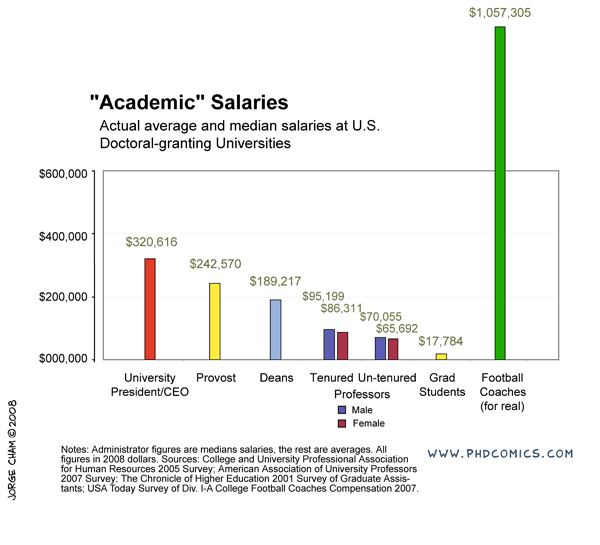
The good news is that I can anticipate earning something closer to the salary for untenured professor, rather than less than the average for grad students (and we just received a personalized letter from OISE, informing us that our stipend was being increased this year so that it would achieve the lofty earnings level of less than the average). The depressing news? Why, oh why, didn't I go for football coaching? That way I could give 110% without worrying about the mathematical hyperbole of it all!
[Technorati tags: academic salary | phd comics]
The good news is that I can anticipate earning something closer to the salary for untenured professor, rather than less than the average for grad students (and we just received a personalized letter from OISE, informing us that our stipend was being increased this year so that it would achieve the lofty earnings level of less than the average). The depressing news? Why, oh why, didn't I go for football coaching? That way I could give 110% without worrying about the mathematical hyperbole of it all!
[Technorati tags: academic salary | phd comics]
20 October 2008
Workplace Learning and Social Change: What's the Link?
This year, I am doing a Graduate Assistanceship in the brand new Collaborative Program in Workplace Learning and Social Change. It is a joint program between the Departments of Adult Education and Counselling Psychology, and Sociology and Equity Studies in Education, here at OISE. The program
If you, or someone you know, might be considering a graduate degree - M.Ed., M.A., or Ph.D. - with a dual research focus in in workplace or organization, and social change or activism, this might well be the program for you. You can find out more by joining us next Wednesday, October 29, 2008, from 17:00 to 19:00 for our opening reception: Workplace Learning and Social Change: What's the Link? It's being held at OISE, 252 Bloor Street West, Toronto in room 5-250. You'll have the opportunity to meet some of the professors and students involved, munch some nibblies, peruse some of the ongoing research, and participate in a small adult ed-y sort of happening.
And if you do attend, make sure you come by and introduce yourself! Hope to see you there.
[Technorati tags: workplace learning | social change | m.ed. | m.a. | ph.d. | adult education | sociology and equity studies | aecp | sese | wlsc | oise]
caters to students interested in developing their understanding of work and learning trends in Canada and internationally with a focus on social change.Essentially, this program enables its participants to
situate workplace learning within broader social trends such as globalization, neo-liberalism and organizational restructuring [while] exploring connections between learning as an individual and social phenomena, [and] identifying learning strategies that foster social change through greater equality of power, inclusion, participatory decision-making and economic democracy.
If you, or someone you know, might be considering a graduate degree - M.Ed., M.A., or Ph.D. - with a dual research focus in in workplace or organization, and social change or activism, this might well be the program for you. You can find out more by joining us next Wednesday, October 29, 2008, from 17:00 to 19:00 for our opening reception: Workplace Learning and Social Change: What's the Link? It's being held at OISE, 252 Bloor Street West, Toronto in room 5-250. You'll have the opportunity to meet some of the professors and students involved, munch some nibblies, peruse some of the ongoing research, and participate in a small adult ed-y sort of happening.
And if you do attend, make sure you come by and introduce yourself! Hope to see you there.
[Technorati tags: workplace learning | social change | m.ed. | m.a. | ph.d. | adult education | sociology and equity studies | aecp | sese | wlsc | oise]
18 October 2008
Political Creativity
One thing to be said about the US Presidential race is how much ordinary people have become engaged in such a variety of creative participation in the conversation that is democracy. Here's a video by an improv group that illustrates the point.
Thanks, Christine!
[Technorati tags: les miserables | obama | mccain | political video | menippean satire]
Thanks, Christine!
[Technorati tags: les miserables | obama | mccain | political video | menippean satire]
15 October 2008
Goodbye Stéphane, We Hardly Knew Ye
Well, I have to admit, Stephen Harper was right about one thing: Stéphane Dion is not a leader. He could not rally Liberal support in yesterday's election, could not see his way to bring the vast Liberal political machinery into play. Consequently, he suffered the worst defeat of any Liberal leader in the country's history: the lowest plurality since Confederation, and a seat count even lower than that of John Turner's disastrous performance. With that, Mr. Dion joins the Kim Campbell Hall of Shame for implosion of a political party.
True leadership, particularly now in our massively interconnected world, must primarily be referent leadership. Legitimate leaders - those who have been appointed or elected to a recognized hierarchical position - are all well and good. They have the right to exercise coercive power (that being, reward and punishment) within the bounds of their respective ground rules, be they corporate or political. But if they attempt to lead without being willingly recognized by those whom they would lead as worthy of leadership - by demonstrating values, vision, tactility, and instilling inspiration and energy among their membership - well, reward and punishment only go so far.
Stephen Harper is a legitimate leader - he won the most seats in our otherwise waste-of-time election. He has gained 18 months of clear sailing for his agenda, since forcing an election before 18 months to two years from now would be political suicide. Besides, the Liberal Party needs to find a new leader and regroup, and it will take all three parties working in concert to bring the House down. But for all the legitmation that Mr. Harper enjoyed last night, the question remains: is he a referent leader?
Clearly, the answer is a resounding NO!
He gained only a point in popular vote. Given that the turnout was a dismal 59% of those eligible - the lowest turnout for a federal election in history - Mr. Harper was endorsed by an equally resounding 22% of the electorate. More than three-quarters of those eligible to cast a ballot rejected Stephen Harper's policies, agenda and record by voting either with their pencil or their feet. All the fuzzy pullovers in the country weren't enough to warm the Canadian public to cold, Conservative divisiveness.
Is Stephen Harper truly a man of his word? To listen to his supporters - indeed, to listen to the man himself - he does what he says he will do. So here's what he said last evening during his very gracious victory speech:
[Technorati tags: stephen harper | stéphane dion | election | leadership]
True leadership, particularly now in our massively interconnected world, must primarily be referent leadership. Legitimate leaders - those who have been appointed or elected to a recognized hierarchical position - are all well and good. They have the right to exercise coercive power (that being, reward and punishment) within the bounds of their respective ground rules, be they corporate or political. But if they attempt to lead without being willingly recognized by those whom they would lead as worthy of leadership - by demonstrating values, vision, tactility, and instilling inspiration and energy among their membership - well, reward and punishment only go so far.
Stephen Harper is a legitimate leader - he won the most seats in our otherwise waste-of-time election. He has gained 18 months of clear sailing for his agenda, since forcing an election before 18 months to two years from now would be political suicide. Besides, the Liberal Party needs to find a new leader and regroup, and it will take all three parties working in concert to bring the House down. But for all the legitmation that Mr. Harper enjoyed last night, the question remains: is he a referent leader?
Clearly, the answer is a resounding NO!
He gained only a point in popular vote. Given that the turnout was a dismal 59% of those eligible - the lowest turnout for a federal election in history - Mr. Harper was endorsed by an equally resounding 22% of the electorate. More than three-quarters of those eligible to cast a ballot rejected Stephen Harper's policies, agenda and record by voting either with their pencil or their feet. All the fuzzy pullovers in the country weren't enough to warm the Canadian public to cold, Conservative divisiveness.
Is Stephen Harper truly a man of his word? To listen to his supporters - indeed, to listen to the man himself - he does what he says he will do. So here's what he said last evening during his very gracious victory speech:
This is a time for us all to put aside political differences and partisan considerations and to work cooperatively for the benefit of Canada. We have shown that minority government can work, and at this time of global economic instability we owe it to Canadians to demonstrate this once again.To be true to his word, that he will work for the benefit of all Canadians, here's what I would suggest:
- Work with Jack Layton on the issue of lost employment, and ensuring Canada's strong social infrastructure;
- Work with Elizabeth May on the issue of climate change and the environment;
- Work with Gilles Duceppe on the issue of preservation and encouragement of Canadian culture (including bringing Michael Geist in on the copyright reform file;
- Work with Stéphane Dion on the issue of Canadian unity, and the problem of fractured regionality and disparity throughout this land; and finally,
- Work with the new Liberal leader, whoever s/he may be, on an overarching economic policy and approach to globalization, both in trade and foreign policies
[Technorati tags: stephen harper | stéphane dion | election | leadership]
08 October 2008
Bad Karma on the Kippur
So it's a mixed metaphor.
Gamar v'chatima tovah! May you be inscribed and sealed in the Book of Life.
Thanks Roberta!
[Technorati tags: yom kippur | karma | high holiday tickets]
Gamar v'chatima tovah! May you be inscribed and sealed in the Book of Life.
Thanks Roberta!
[Technorati tags: yom kippur | karma | high holiday tickets]
Subscribe to:
Posts (Atom)